

USAR teams and disaster planners embrace a feisty new rescue unit that’s compact, highly mobile, remarkably capable, and won’t bust your department’s budget.
 When the U.S. military developed the rapid deployment force concept, it made sense to a lot of people; less dependence on unwieldy heavy armor (main battle tanks) and more emphasis on a lighter, more mobile, and less costly force that could quickly respond to unforseen conflicts.
In a world that’s rapidly changing, disaster planners face similar needs today. They need greater maneuverability to access congested disaster sites that may include interior of buildings, parking garages, tunnels. And they need a less costly product than their main battle tank (heavy rescue truck) in order to afford the number of units necessary to cover major natural disasters, terrorist incidents, or even fifty car pileups on a fog-bound freeway.
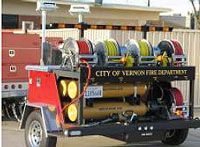
Several years ago the product development team at Foster Rescue Products decided the time was ripe to tackle these issues. Borrowing from the military rapid deployment force concept, they designed what they call an Auxiliary Rescue Unit (ARU) in a light, compact, and fully self-contained trailer format that can be dropped off at disaster sites and run independently for days. Their design criteria included air liftability, as well as all of the rescue fundamentals of scene lighting, hydraulic extrication tools, air bags, compressed air, electrical power, foam fire suppression, and breathing air. The unit weighs only between 2800 and 3800 pounds, depending on options, and can be pulled by virtually any vehicle, from SUVs to even ATV’s for off-road scene access. Once at the disaster scene it’s wheeled jack allows it to be pushed around by hand by two firefighters.
The concept seems to be gaining in acceptance, particularly among USAR teams. Mike Langer, Captain of the Vernon City, California USAR team, says his department bought one to augment their heavy rescue truck force because it gave them the capability of attacking a disaster scene from two points, as well as accessing sites the rescue truck couldn’t negotiate. Vernon City configured their unit with two electric reels and two air reels, allowing them to run a four-man saw and nail gun team for emergency building and shoring. The ARU also serves as a backup when their heavy rescue is out of service, and doubles congested disaster sites that may include as an air trailer for big fires. Moreover, says Langer, it was affordable and hasn’t had a significant impact on their operating costs.
Keesler Air Force Base Fire Chief John Rulapaugh added an ARU to his fleet primarily for mobility. “Our Special Ops team has to cover a lot of turf; beachfront, railway sites, barges, and crash sites in wooded terrain... all places where we can’t get our rescue truck. We can get the ARU to all of them, usually with a 4x4, but if necessary by boat, or chopper. I also needed more air for major fires. The ARU met all those needs, and for us, the ability to air lift was a plus.”
Foster says nicely equipped base models sell for as little as $50,000, including hydraulic tools, ready to be put into service. This may mean that for the first time, disaster planners will find it financially feasible to consider purchase of multiple units that can be held ready in reserve for the big one. Indeed, that may be happening. Foster says they have quotes out for as many as 26 units to a single customer. Time will tell whether the ARU concept gains a deep foothold in the fire service, but the concept is particularly among intriguing, and the technology fascinating.