

Strategies for combustible metal deck roofs
This may look like a noncombustible roof void that doesn’t require sprinklers, but as the song goes, “Taint necessarily so.”
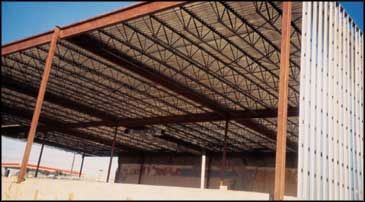 PHOTO FRANK BRANNIGAN |
The roof above the void is a combustible metal deck roof (CMDR) that consists of multiple layers of tar and roll roofing. You can determine which structures in your area have a CMDR before a fire by looking for roofs covered with this so called built-up roofing.
It takes 12 lbs. of tar per square foot to glue down the roof. When the underside of the roof is exposed to temperatures of 800° F or higher for as little as five minutes, the tar creates flammable gasses that create a self-sustaining fire under the metal roof, regardless of the building’s contents. The gasses can’t escape upward due to the multiple layers of roofing, so they flow downward and pour through the joints in the metal roof, further heating and weakening the steel.
Only sprinklers installed above the ceiling to cool the steel are effective for these fires. Sprinklers below the ceiling are not. A ceiling installed below the trusses is most likely intended to limit flame spread only and does not provide rated fire resistance.
Do not attempt to vent such a roof. A six-firefighter roof crew with the Dallas Fire Department fell into the fire when elongating bar joists pushed down the block wall.
Fortunately, they were near the edge and were quickly recovered. In St. Paul, Minn., 20 firefighters were rescued from a strip mall just 60 seconds before a major CMDR collapse. In both of these fires, no one on scene knew they were dealing with a CMDR at the time. In a recent fire, two Memphis, Tenn., firefighters died in what, I’m sure, was a CMDR fire.
To extinguish this type of fire, work from a safe location outside the building, and use a heavy solid stream to tear out any remaining ceiling and cool the steel. A tower ladder bucket located just outside the doorway could be very efficient in cooling the steel
Special note: The procedure noted on p. 308 of “Building Construction for the Fire Service, 3rd Edition,” is not recommended because a collapse in one area may bring down the whole roof.
Remember that a membrane roof — a glued-down sheet of plastic — does not have enough substance to create a CMDR fire, but may generate dripping, flaming adhesive, which can ignite the building’s contents. (See “Building Construction for the Fire Service, 3rd Edition,” p. 302, which shows “icicles” of dripping tar — an indication of a CMDR fire — frozen by a hose stream. See p. 302–308 for more information.)
I urge all fire departments to survey all flat-roof (and some curved-roof) buildings in their area for bar-joist roofs and determine their roofing types. If it’s a built-up roof with tar and roll roofing, it’s a CMDR. Ask the occupants if they know whether a tar pot was used in the roofing work. Make sure the hazard information is archived at alarm headquarters so it can be included in all dispatches. Note that bar joists are also vulnerable to early collapse from building contents; cool the bar joists if safely possible. Be prepared for post-fire “experts” who will moan about water damage to unburned contents. Nothing under a collapsed roof is salvageable.