

A large masonry building may actually utilize a lightweight truss roof
This building is considered a concrete building because the floors are concrete, but this “undressed building” photo, taken when the building was under construction, reveals a lightweight truss roof. Many substantial-looking masonry buildings have lightweight truss roofs. When preplanning, ask building maintenance staff about the roof structure.
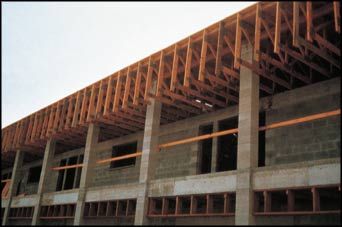 |
List a roof like this in a file at alarm headquarters so the alarm office dispatch sounds something like this: “Fire reported at 2227 Elm Street. The building has a lightweight wood truss roof.” On scene, roof units should use a thermal-imaging camera to determine if there’s fire in the trusses. If there is, evacuate the roof and floor below.
As long ago as 1971, in the first edition of “Building Construction for the Fire Service,” I warned against the hazard of trusses. On page 87 I wrote, “In the case of a lightweight trussed roof, if there is enough heat and fire to require ventilation, men ventilating the roof should be supported independently of the roof.” Unfortunately, many in the fire service were (and remain) unable to comprehend a hazard until a bad experience occurred, and then only if they were aware of it personally. Ben Franklin once said,
“Experience is a great teacher but keeps a dear school, but fools will learn in no other.”
In our field, experience is bought with blood and tears. Many firefighters have died due to the obdurate refusal of supervisors to learn from the experience of others. Some think it unseemly to discuss the errors of “dead heroes,” or the errors of management that cause a disaster. When I started discussing building construction in1966, it was accepted that some firefighters would inevitably be killed on the job. I set out to change this, and I keep working at it.
Francis (Frank) L. Brannigan, a fireground commander in the 1940s and a fellow of the Society of Fire Protection Engineers, was named one of the 20 most influential people in the fire service by Fire Chief Magazine. For 37 years, Brannigan has defined building hazards for firefighters. His book, “Building Construction for the Fire Service, Third Edition,” is available from the NFPA.