

A discussion of compression, tension & shear forces
This column supports Chapter 2 of my book, Building Construction for the Fire Service, Third Edition (BCFS3). This chapter, called Principles of Construction, is difficult for some to teach or even study because it introduces a new vocabulary and changes the definitions of some words as we know them.
External forces like gravity and wind constantly push and pull on structures, which resist these loads via a variety of support structures. When a structural fire occurs, firefighters must know what’s holding the building up and how the fire might affect the support structure, which makes an understanding of forces critical.
- Forces are applied in one of three ways:
- Compressive forces, which are crushing loads;
- Tensile forces, which are pulling loads; and
- Shear forces, which are sliding loads.
Here’s some quick, “hands-on” illustrations of those forces. Put your hands together and push their heels against each other — that’s compression. Put your hands together with fingers curled and pull them against each other — that’s tension. Put your hands together flat and tight, then slide one hand downward — that’s shear.
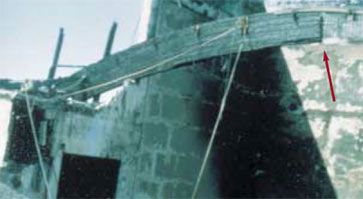 This is a curved, laminated-wood segment of an arch. Look carefully in the upper right corner and see the steel connector. The connector failed in a fire, dropping a section similar to the one visible here. This building had been roofed with foamed plastic. The owners sued the roofer, arguing “your fast-burning plastic destroyed our wonderful fire-resistant heavy timber building.” I was as an expert for the defense, and when I produced the picture before the trial showing how the building fell apart due to the metal connections, the suit was dropped. |
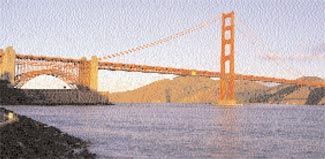 PHOTO GETTYIMAGES.COM The suspension bridge picks up the deck’s load on cables, which are in tension. The cables deliver the load to the towers, which deliver it to the ground in compression. The ends of the cables are attached to steel bars at right angles. The bars are buried in a massive concrete abutment that’s adequate to resist the shear load. |
When you look at a structure and see a significant load, trace a path to the ground to identify the load’s support structure. Note: These loads can shift from tension to compression and vice versa along the path to the ground.
In addition, the materials may vary in their inherent resistance to fire along this path. Example: The wood industry brags about the inherent fire resistance of laminated wood beams compared to unprotected beams, but neglects to mention that metal connectors often join beams and many (if not most) wooden beams deliver their load to unprotected steel columns.
In December 1991 fire in
The following photos and drawings illustrate the three forces.
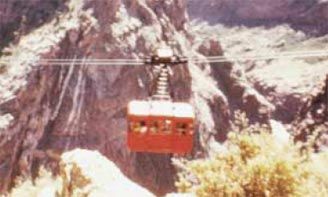 Cable-supported structures, such as suspension bridges and aerial trams, are directly descended from vine- or rope-supported bridges built by aboriginal people in mountainous countries. The cables are secured to posts driven into the earth or by heavy concrete anchors. The cables try to shear out of the anchor or cause the post to shear out of the earth, but adequate anchors will resist this force. The cold-drawn steel cables that support this aerial tram will fail at 800 degrees F. |
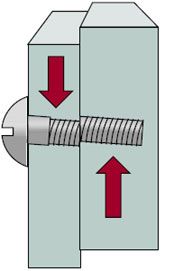 | One of these metal plates is fixed, but the other can slide. A bolt connects the plates and transfers the shear load. If the bolt is not adequate, it will shear off. |
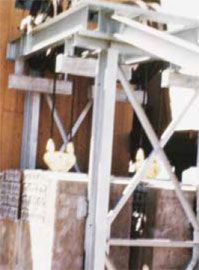 | A fire in this combustible tram station could cause the cables to sag and strand passengers high in the sky. If you have such a structure in your area, think about how you would handle such a problem. Pursue every effort to prevent a fire in such stations. Smoking should be prohibited. Flammable storage should be eliminated. It might be feasible to paint the entire structure with fire-retardant paint. Foliage and trash should be cleared from around the station. If anybody hears a cogent reason why fire was not a consideration in building a wooden station, I’d like to hear it. This station should be replaced with a noncombustible building. In a terrible fire in a combustible funicular railway car in the Austrian Alps, 155 skiers died. |
Francis (Frank) L. Brannigan, a fireground commander in the 1940s and a fellow of the Society of Fire Protection Engineers, was named one of the 20 most influential people in the fire service by Fire Chief Magazine. For 37 years, Brannigan has defined building hazards for firefighters. His book, Building Construction for the Fire Service, Third Edition, is available from the NFPA.