

By Monifa Thomas
The Chicago Sun-Times
Copyright 2006 Chicago Sun-Times, Inc.
All Rights Reserved
They were on their way to rescue a person in distress off North Avenue Beach. But the crew of a Chicago Fire Department helicopter found themselves in trouble Friday when they had to make a hard emergency landing on the lakeshore.
The two pilots and two divers on board suffered minor injuries, but damage to the helicopter, which came to rest upside down near 3900 S. Lake Shore Dr., was extensive, Fire Department officials said.
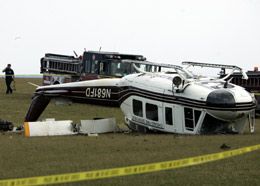 A Chicago Fire Department helicopter lies upside down after making an emergency landing on Friday. (AP Photo/Julio Cortez) |
The reason for the emergency landing is still under investigation.
The noon crash happened as the helicopter was en route to North Avenue Beach, where a man was reportedly having trouble in the water.
The pilot called in an air emergency, saying he was “experiencing some trouble keeping the helicopter airborne,” Fire Commissioner Raymond Orozco said. He managed to guide the chopper down to a grassy area between Lake Shore Drive and the lake.
A witness said the helicopter came down hard and then rolled over.
The four men on board were taken to Northwestern Memorial Hospital and Cook County Hospital. Two were “stable” Friday evening, while two others had been released, Orozco said.
SOUTH LAKE SHORE DRIVE CLOSED
The person in distress, identified by police as a 52-year-old man, was pulled from the lake and taken to Northwestern Memorial Hospital, where he was listed in critical condition late Friday. Details of the rescue were not immediately available.
Chicago Police temporarily closed South Lake Shore Drive near the crash site, creating major delays.
The National Transportation Safety Board is investigating.
The helicopter is one of two used by the Chicago Fire Department for air and sea rescues, Orozco said. Last year, the choppers went out on 175 rescue missions. Crashes are “very rare,” department spokesman Kevin MacGregor said.