

The Associated Press
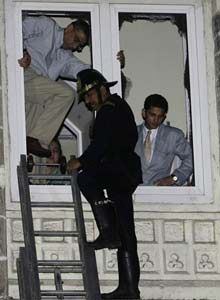 AP Photo/Gautam Singh A firefighter rescues guests of The Taj Hotel in Mumbai, India, on Thursday, Nov. 27. |
MUMBAI, India — Deepak Kuntawala felt it was only a matter of time before the four gunmen roaming the Taj Mahal hotel would find him and more than 100 others hiding inside the first floor lounge. So he organized a breakout.
As smoke billowed in from surrounding fires, Kuntawala led the guests and staff to another room and split them into three groups. One tore down curtains to make ropes, another used table cloths and the third cleared space near the windows for them to escape.
It took half an hour for everyone in the room to shimmy down the makeshift ropes thrown out of three windows.
“I still can’t fathom why they didn’t come into our room,” said Kuntawala, 35. “We are all lucky to be alive.”
Since before the smoke cleared from the rubble of the deadly Mumbai attacks, public anger has been building toward politicians and security officials for botched intelligence and threadbare security.
But everyday heroes have begun to emerge, and their stories of tenacity, endurance and bravery have helped buoy the spirits of this traumatized city.
Kuntawala was one of more than 20 people honored Saturday by city officials for heroism during the attacks that left 171 dead across India’s financial capital.
“The city should be very proud of these people. Mumbai is a cosmopolitan place and all castes and different people came together to help each other,” said K.A. Viswanathan, one of the ceremony’s organizers.
During the siege, Kuntawala, the London-based owner of a private equity company, heard fierce fighting and grenade explosions outside the lounge. At one point, he saw one of the rampaging attackers through the frosted glass, but the gunman was turned sideways and didn’t see them, he said.
He grew convinced that after more than four hours in the room, it was time to make a move.
His idea of using makeshift escape ropes might have saved the lives of everyone trapped in the room. The only injury was a broken leg suffered by Kuntawala’s father, Vinay, 68, who lost his grip and fell.
There were other stories of heroism from the three-day siege.
Mumbai fire chief Anil Sawaant and senior firefighter Pratab Karguppikar were honored for braving gunfire and flames during repeated trips in a cage attached to a fire truck ladder to rescue dozens trapped on the hotel’s higher floors.
The men used their axes to break through the windows and bring groups of hotel guests and staffers down to safety.
“We heard a lot of shooting,” Karguppikar said. “There was a lot of cross-firing.”
The two men made about eight trips each in the cage, bringing down four or five people each time, they said.
On one trip, Sawant saw one of the gunmen and is convinced the gunman saw him, but he still managed to rescue people from a neighboring room.
Despite the rescue efforts, many did not survive.
Dr. Prashant Mangeshikar, a gynecologist, was honored for the six hours he spent trying to save a gunshot victim inside the building.
Mangeshikar had been attending a cocktail party at the hotel with his wife and daughter when the mayhem started. After several hours, they and 300 others tried to escape, he said.
The gunmen opened fire. “The guy in front got hit by a bullet in the back and his intestines came out the front,” he said.
Mangeshikar and his wife used their bare hands to try to keep his organs inside him. For six hours, they barricaded themselves in a room with the wounded hotel employee, giving him pain pills and trying to comfort him, he said.
Eventually, the Indian security forces arrived and took him to the hospital. But he was too badly wounded, Mangeshikar said.
“They operated but his spleen was ruptured and his intestine was lacerated and he’d had six hours of exposure,” he said. “He died on the fourth day.”