

By Jamie Thompson
FireRescue1 News Editor
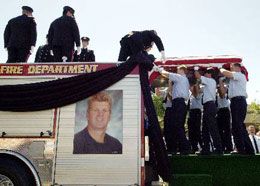 AP Photo/Matt York Firefighters load the casket of Bret Tarver onto a fire truck following a funeral service in March 2001. |
Bret Tarver and Mark Carter – both Phoenix firefighters, both died while on duty.
The pair shared one other thing in common – neither left wills, an oversight that unfortunately added to their families’ difficulties after the tragedies.
Despite the dangerous nature of the profession, situations such as these are not unusual in the fire service. Earlier this year, it was reported that several of the nine firefighters killed in the sofa store fire in Charleston, S.C., in June also had not drafted wills.
But help is at hand for firefighters and other first responders across the country. For the past six years, the Wills for Heroes program has been offering free legal help to emergency services personnel in writing their wills and other legal documents.
Co-founder Anthony Hayes said he was shocked after discovering the number of first responders without wills.
“I couldn’t understand how somebody whose job involves literally putting their lives on the line didn’t have something in place,” he said.
Hayes launched the initiative in his home state of South Carolina in the wake of 9/11.
Profound effect
Having previously worked in the World Trade Center, the terrorist attacks had a particularly profound effect on the lawyer, a partner at major national law firm Nelson Mullins Riley.
He e-mailed the City of Columbia (S.C.) Fire Department, asking what lawyers could do to help it. After word came back that many of the firefighters did not have wills, Hayes decided to begin offering free estate planning services and launched the Wills for Heroes initiative.
Since its inception, more than 6,000 wills have been drafted at no charge for firefighters, police officers, EMTs and corrections officers. The cost of drafting a will would normally cost as much as $1,000.
“We make our livelihoods out of the community, so this is our way of giving something back to the community,” Hayes said.
“The foundation itself does not provide legal services; we are the facilitators to help each state get the program up and running. Our goal is to get lawyers and first responders together and make it happen.”
The drafting procedure is relatively simple. The Wills for Heroes Foundation arranges for local attorneys to visit the department station, training facility or headquarters, armed with laptops and the relevant programs and legal documents.
Planning questionnaire
Prior to the meeting, the first responder needs to complete an estate planning questionnaire in which they must indicate who they want to appoint as guardian for their children, who will be the executor of their will, and what their wishes are in case they are in a terminal condition, irreversible coma or persistent vegetative state.
At the meeting itself, the first responder meets with a volunteer attorney who inputs their information from the estate planning questionnaire. A customized application merges the first responder’s information into the state-specific estate planning documents and creates a will, living will and powers of attorney.
The attorney reviews the draft estate planning documents with the first responder to make sure they understand and agree to the plan. Once the documents are finalized, they are signed, witnessed and notarized at the event so they are effective immediately. The whole process takes about 30 minutes.
Jeff Jacobson, who expanded the project with Hayes in 2004, making it a nationwide foundation, said that he believed there are two main reasons why so many first responders do not have wills.
“I think that most responders are heroes and are fearless,” he said, “and to be these things, I think you have to have an emotional component that nothing is going to happen to you.
“These are the people running into the building when we are all running out or doing the 3 a.m. traffic stop, not knowing who or what is in the car. If you acknowledge the fact that something might happen to you, you might not run into that burning building.”
Young responders
In addition, Jacobson said he finds many young first responders believe that because of their age and lack of assets, there is no point in having a will.
“It may well be the case that you don’t have anything, but it may not be true if something does happen to you,” Jacobsen said, referring to memorial funds such as those set up in Charleston after the firefighter deaths.
In Phoenix, where firefighters Tarver and Carter died without leaving wills, more than 300 members of the fire department took part in a Wills for Heroes session earlier this year.
Firefighter Tarver died in 2001 after being trapped by debris during a raging fire at a west Phoenix shopping center, while Firefighter Carter collapsed during a lunch break in June and could not be revived by his colleagues.
“When you lose one of your firefighters it’s bad enough, but when their things go into probate because they didn’t have wills, it makes it even more trying and taxing for their families,” Phoenix Fire Chief Bob Khan said.
“But when you’re in the fire service, you can think you’re unbeatable and don’t always look down the road and think what could happen.”
Khan said that he was delighted at the response of his department in completing wills at the Wills for Heroes session.
“As a fire chief, to go to the event and see young firefighters with baby strollers was very rewarding for me, to see them making sure their children and partners are taken care of,” he said.
- For more details on the Wills for Heroes Foundation or to arrange an event at your department, go to WillsforHeroes.org.