


By Emergency Management Coordinator Eric Baumgardner
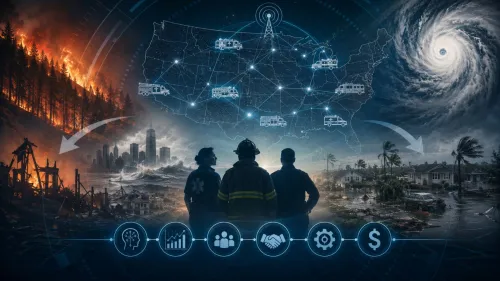
No jurisdiction should face complex emergencies alone. Communities must rely on one another to share resources, coordinate operations and support one another when local capabilities are strained. This is why collaboration is a cornerstone of effective emergency response, whether built through longstanding partnerships, formal agreements or informal professional relationships.
Problems can arise, however, when emergency management programs evolve independently — when neighboring jurisdictions develop their own Emergency Operations Center procedures, planning processes, training programs, preparedness campaigns and mitigation initiatives, despite facing many of the same hazards and challenges. In other words, while collaboration is expected during an emergency, it is far less common before one occurs. This observation led Burbank (California) Fire Department leadership to ask a simple question: If collaboration strengthens emergency response, why shouldn’t it strengthen emergency management before an incident as well?
| READ MORE: Community Emergency Response Teams: Fire service force multiplier and CRR tool
The challenge
Working as the emergency management coordinator for the City of Burbank — an agency fortunate enough to maintain a dedicated emergency management division within our fire department — this question became increasingly difficult to ignore. Although Burbank has had a full‑time professional emergency management coordinator for just over a decade, the city previously relied on a rotational 40-hour fire captain to fulfill this role. Each time the position changed hands, institutional knowledge walked out the door with it. The result was a cycle where just as someone became familiar with prevention, mitigation, preparedness, response and recovery, their rotation ended, and the learning process began again with the next individual. Long-term initiatives struggled to gain traction, and sustained program development became nearly impossible, especially for complex multi-year projects.
As I engaged with colleagues across California, it became clear that Burbank’s experience was the norm rather than the exception. California has been a late adopter in recognizing emergency management as a profession. Of the state’s 58 counties, most emergency management programs operate within the county sheriff’s department or fire department, with only a handful functioning as stand‑alone departments or offices under a chief administrative officer or chief executive officer.
Additionally, staffing models vary widely at the county level, some with dedicated professional emergency management personnel, others with sworn staff who rotate through the role every few years. Among California’s more than 450 incorporated cities, fewer than one-third assign anyone full time to emergency management. And even when cities maintain an emergency management division or unit, the position is often housed within a police or fire department and filled through temporary rotations by law enforcement sergeants or lieutenants, fire captains or battalion chiefs. In cities without their own police or fire department, the role is frequently assigned to mid‑level civilian staff as a collateral duty alongside their primary responsibilities.
These personnel often enter the assignment with limited background in emergency management. By the time they complete foundational FEMA independent study courses or California Office of Emergency Services (Cal OES) in-person training and begin to understand the terminology, regulatory requirements, operational frameworks and long-term planning needs, their rotation is nearing its end. It is understandable why some hesitate to initiate complex mitigation projects or multi‑year preparedness initiatives that they will not be there to complete.
These agencies excel in response and public preparedness outreach, but broader mitigation and recovery planning frequently remains underdeveloped. In an era where regulatory expectations, recovery complexities and cost‑reimbursement processes continue to expand, the absence of sustained professional expertise creates real challenges.
In contrast, many parts of the Midwest — where fire agencies are often volunteer and emergency management stands alone as a discipline — have long embraced the profession as a dedicated skillset. While there is no definitive national dataset quantifying the preparedness difference between jurisdictions with full‑time emergency managers and those without, FEMA reviews, audits and case studies consistently demonstrate the benefits of sustained professional expertise. Communities with professional emergency managers show stronger mitigation outcomes, improved regulatory compliance and more effective long-term recovery.
But acknowledging the value of professional emergency management is not the same as expecting every city to hire a full‑time coordinator. While every community benefits from professional emergency management expertise, many jurisdictions — particularly smaller cities — must balance that need against competing fiscal realities. Rather than viewing that as a limitation, we began asking how neighboring jurisdictions could collectively expand capability by sharing expertise, standardizing processes and reducing duplication of effort.
Emergency management has always depended on relationships. The next evolution is intentionally building those relationships into a structured regional framework that shares knowledge, standardizes operations and strengthens preparedness long before an Emergency Operations Center is ever activated. And that evolution is where Burbank’s story begins.
Building the Emergency Management Cooperative
Several years ago, supported by Burbank’s fire chief and city manager, I began exploring whether the longstanding partnership among the cities of Burbank, Glendale and Pasadena could serve as the foundation for a more intentional emergency management collaboration. All three cities faced similar hazards, similar operational demands and similar challenges in developing and maintaining EOC programs. At the time, two cities had full‑time professional emergency management coordinators while one still relied on a rotating fire captain, although today all three cities have full‑time coordinators. Most importantly, all three agencies shared a desire to strengthen preparedness beyond their individual capacities.
The initial concept was simple: Create a tri‑city partnership where each jurisdiction could rely on the others for emergency management support during leave, major incidents or prolonged EOC activations. We envisioned a system where emergency managers could serve as liaisons at incident command posts, assist in key EOC roles for neighboring cities or provide relief during extended operations. Beyond incident support, we aimed to standardize EOC processes, terminology and forms across all three cities. If we could align our procedures, then trained personnel from any city would be able to augment another’s EOC seamlessly. Emergency management isn’t built by plans on shelves; it’s built through relationships established long before they’re needed.
As we discussed the idea informally with colleagues in other cities, including agencies in neighboring counties, interest grew rapidly. Some jurisdictions had full‑time coordinators, others had rotating staff, and some assigned emergency management as a collateral duty to individuals with no dedicated training. Regardless of structure, nearly everyone faced the same challenges. What began as a tri‑city concept quickly expanded into a regional vision: the Emergency Management Standardized Cooperative for Operational Response and Education.
A steering committee representing multiple cities, led by Burbank, formed to develop the framework. Together, we began reviewing best practices from across the region and comparing them with state and federal requirements. Our goal was to create standardized EOC position descriptions, terminology, forms and processes that reflected the strongest elements of Cal OES and FEMA doctrine. This was not about replacing existing guidance; it was about streamlining and operationalizing it in a way that made sense for local government.
Training became a central pillar of the cooperative. Rather than having each city independently develop and deliver its own EOC curriculum, we began creating a comprehensive training program — grounded in Cal OES and FEMA standards — that would be delivered in regional cohorts. Each cohort would consist of participants from multiple jurisdictions, hosted at rotating cities and taught by emergency managers from member agencies. This shared approach reduces the burden on any single city while significantly expanding access to high‑quality, standardized instruction.
The concept builds on a model used by the western-most cities of San Bernardino County, where neighboring jurisdictions jointly deliver EOC training, and on a subsequent program developed by several Los Angeles County Disaster Management Area Coordinators (DMACs) to fill training gaps for smaller cities. The cooperative’s goal is to take the evolution of these models a step further by expanding the curriculum with additional modules, strengthening standardization and creating a framework that remains adaptable over time. By designing the program to be modular, regions outside our own can remove, modify or add components to meet their specific needs, ensuring that the training remains both scalable and sustainable for years to come.
Beyond training and EOC standardization, the cooperative is assembling a shared resource library to support mitigation, preparedness and public education. Member cities are contributing templates, campaigns, public messaging materials, alert and warning language, mitigation strategies and operational best practices. For smaller jurisdictions — or those with rotating or collateral‑duty emergency management staff — this shared library provides instant access to materials that might otherwise take years to develop.
California’s Standardized Emergency Management System (SEMS) emphasizes solving problems at the lowest level of government and relying on local partnerships before escalating requests up the chain. Our cooperative embodies that principle. By working together, local jurisdictions expand each other’s capabilities, reduce duplication of effort and strengthen regional resilience. The model is intentionally scalable. While our story is rooted in Burbank and the greater Los Angeles area, the framework can be adapted for any region in California or across the country. It is simply a structured approach to something emergency managers have always relied on — helping one another.
A model other communities can follow
The Emergency Management Standardized Cooperative for Operational Response and Education did not begin with the goal of creating another organization. It began with a simple belief that neighboring jurisdictions could accomplish more together than any of us could independently. As the cooperative continues to grow throughout Southern California, our hope is not simply to strengthen our own region, but to demonstrate a framework that other communities can adapt to meet their own needs. If that happens, then the cooperative will have achieved something far greater than standardized forms or shared training. It will have strengthened the profession of emergency management itself by proving that preparedness, like emergency response, is most effective when built on collaboration, trust and a commitment to helping one another before disaster strikes.

ABOUT THE AUTHOR
Emergency Management Coordinator Eric Baumgardner has more than 25 years of public safety and emergency management experience. He began his career with the County of Los Angeles before moving to the City of Los Angeles and ultimately joining the Burbank Fire Department in 2013. Baumgardner is a graduate of the FEMA Emergency Management Advanced Academy and holds an Emergency Management Specialist certification from the California Office of Emergency Services. He is also recognized as a California Professional Emergency Manager (CA‑PEM) by the California Emergency Services Association.
Baumgardner has been recognized as an expert witness in emergency planning by the United States District Court and has testified as an emergency management subject matter expert before the California State Assembly. He has responded to numerous local, state and federally declared disasters across the country in a variety of roles within Emergency Operations Centers through emergency management mutual-aid deployments, as well as assignments on Incident Management Assistance Teams (IMAT) and Incident Management Teams (IMT).
