

By Jamie Thompson
FireRescue1 News Editor
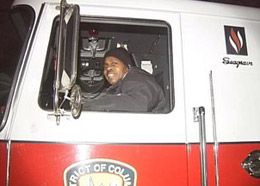 Photo courtesy of WUSA9.com/STATter911.com Michael LaCore returns home aboard Engine 6 after being released from the Washington Hospital Center last month. |
When you’re injured on-duty, recovering is only half the battle — it can be more about getting fit in the time your department allows you to before you’re retired.
With the seemingly arbitrary forced retirement policies that vary from department to department, you could be retired in as little as six months. But a firefighter in a neighboring department can have twice the length of time to recover from injury before being allowed to return to work.
The issue has been gaining much attention in Washington, D.C, in the aftermath of a blaze at a Capitol Hill rowhouse that seriously injured two firefighters, Michael LaCore and Charlie Shyab.
Under the current legislation in D.C., injured firefighters are given 192 days or 64 work shifts to recover. If they can’t return following that period, they must retire and accept a disability pension.
Emergency legislation passed last week extended that period for the two injured firefighters to two years, and D.C. Fire Chief Dennis Rubin and local politicians are now working toward extending the legislation to cover all firefighters who are burned.
D.C. Mayor Adrian Fenty told the Washington Post he had been unaware of the time limitations and was “personally surprised” that firefighters who are still recovering after a year are not allowed to return to their jobs.
To clear up any confusion, a national, consistent standard needs to be introduced, according to Paul Antonellis, who spent more than 20 years in the fire service before retiring — voluntarily — as chief of the Salisbury, Mass., Fire Department.
He has since worked for several colleges, teaching graduate and undergraduate fire service programs, and takes particular interest in the issue of forced retirements and the different policies created by departments.
“It can be six months, it can be two years, because there’s no national standard,” he said.
Be proactive
Even if the firefighter can never return to full active duty, Antonellis said, departments need to be more proactive in finding ways of re-employing them away from the front line such as human resources.
Alternatively, firefighters can still utilize the skills gained pre-injury in areas such as teaching, insurance fire investigations and fire equipment companies, Antonellis added.
“There are a lot of things that retired firefighters can offer back to the system,” he said.
However, sadly there are some who will never be able to return to the department in any capacity, no matter how long they’re able to be off sick.
For those undergoing a forced retirement, it’s vital to keep active as much as you can to ward off the threat of depression, according to Antonellis.
One way for a retired firefighter to both offer something back to the system and to keep active, Antonellis said, is becoming a mentor to anyone else who has found themselves in a similar predicament.
It’s a route that has been taken by Brian Kvederas, a former Morristown, N.J., firefighter who was forced to retire last year after breaking his neck during an incident two years ago.
He suffered the injury while fighting a fire during adverse conditions of a heavy winter storm. He was alone on a hose line when these conditions, explosions and the pressure of the line snapped his neck backward and he was thrown to the ground.
Kvederas said his injuries were repeatedly misdiagnosed by doctors and that he never got the treatment he needed. This lack of care, he said, is indicative of the way firefighters are often let down when they themselves need taken care off.
“People who put their lives on the line day in, day out should be given a golden ticket if they’re injured, where everything that can be done is done to make sure that person is well and whole again,” Kvederas said.
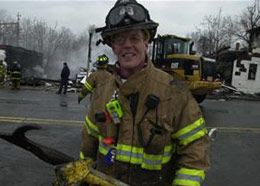 Photo courtesy of Brian Kvederas Brian Kvederas pictured on-duty before his accident. |
After being forced to take early retirement about a year after the accident, Kvederas said it became evident he would receive little assistance from his former employers.
“There’s a big misconception out there too, that the brotherhood will take care of you, that everyone sticks together,” he said. “I didn’t find that. For some, I think it’s easier to deny something has happened in case it happens to them.”
Emotional support
Kvederas has now embarked on a campaign to help firefighters who find themselves in similar situations. Three months ago he launched the Emergency Service Workers Foundation, which aims to offer advice and emotional support to those who find themselves with nowhere else to turn.
“Through this website I want to turn a bad situation into a good one and help other people,” Kvederas said. “I want to establish a program where basically step by step people can be helped through the process as I know how frustrating it can be.
As the project develops, Kvederas said he hopes to be able to define specific action plans to first help ensure individuals receive the correct treatment if they’ve been injured, and second to take them through the legal minefield forced retirements can be.
For Kvederas, it’s almost an extension of being a firefighter. “It’s in my nature to help people,” he said, “I can’t just put the blinders on now.”
Like Antonellis, Kvederas is also campaigning for departments to take a more active role in finding suitable new posts for injured firefighters.
“It would be like them saying, ‘You’ve helped us for X amount of years, now how can we help you?’”
Working on the website with Kvederas is Kelly Aldridge, whose husband, Floyd, a former D.C. firefighter, had to retire after an accident in April 2005 left him with severe knee and arm injuries.
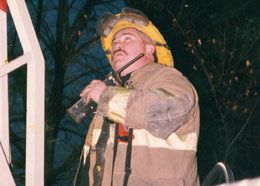 Photo courtesy of Kelly Aldridge Floyd Aldridge at the scene of a fire before his accident. |
The couple, who have four children, has been forced to move in with his father because of financial hardship.
Aldridge said that she hoped she would be able to help other retired firefighters and their families through her involvement in the website.
“We want to help them get the help and advice they need and what they need to do to get medical care,” she said.
Their children have been hit particularly hard, she added.
“They don’t understand that while their dad protected people, there doesn’t seem to be anyone there to help him now he needs it,” Aldridge said.
| Related Resources: Emergency Service Workers Foundation (Eswfoundation.org)D.C. officials work to ensure injured firefighters aren’t forced to retire |
| Discuss this article at FireRescue1 Forums |