

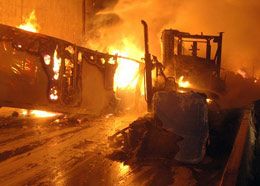
| Editor’s note: A fiery pileup around a freeway tunnel north of Los Angeles in October proved extremely testing for responders. The crash involved five to six big tractor-trailer trucks and several passenger cars; at least five of the trucks burst into flames, and the fire spread to the other vehicles. Captain Tom Stukey, of L.A. County Fire Department’s Station 73, served as the initial incident commander and gives his recollections in this end-of-year article. |
 AP Photo/Mike Meadows |
We didn’t really have a view of it pretty much until we were right on top of it. We asked for assistance from both L.A. County and L.A. City and a number of non-emergency agencies.
Our biggest challenge was really three-fold. The number one priority was finding out how many victims we had and if anyone was trapped. Second was figuring out what hazardous materials, chemicals, volatile stuff we had in those trucks. Third, which really changed the shape of the incident, was to get the freeway shut down and provide ourselves with a water source up to the incident.
We didn’t know if we had five victims in there or 105 victims. Once we had that established, that really drove the incident. When we arrived, it was dark, it was raining, there wasn’t any moon — but then there were 75ft fireballs rolling out of this thing.
It wasn’t until paramedics arrived on the south side that we realized this incident extended another half mile south of the tunnel, so it was a very long, complicated incident. I ended up being the incident commander for about 45 minutes prior to the battalion chief coming on the scene, due to the severe traffic backup.
The complexity for the CHP was to get that freeway shut down and all the arteries running into it. In that area, traditionally we get very poor radio communications, which all added to the mix; intermittent cell service, scratchy radio at times.
The biggest thing once we had got our victims transported, and I remember saying this on the radio, was the possibility of a freeway collapse. We really had concern with structural integrity.
Because we knew that nothing was going to be alive in the actual tunnel, we let the fire for the most part burn itself out so that later we could get structural engineers to make sure it was safe.
We later found that some of the drivers had ended up being pretty much incinerated within their vehicles because they were trapped and we were unable to get into the tunnel.
Related Article: Firefighters sift through wreckage of Calif. tunnel inferno |