

By MATT KAPKO
News Editor, FireRescue1
CARLSBAD, Calif. — The captain on the first-arriving engine company at the scene of a plane crash in Carlsbad, Calif., Tuesday morning, today recalled his on-scene experiences and fire-attack strategies.
Carlsbad Fire Department Capt. Richard Vance’s three-person company, which works out of the station closest to the airport, responded to the scene following the first alarm and immediately saw large, unconnected fires approximately 100 feet wide and 40 to 50 feet deep overall.
“There were spot fires and burning debris and burning fuel all around us,” Vance said. “Initially probably the largest fire was the wreckage of the aircraft itself and the ignited fuel that had spread.”
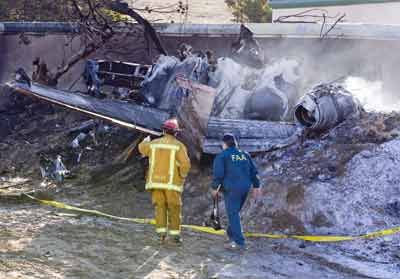 | An FAA investigator, right, and a Carlsbad firefighter, left, look over the wreckage of a plane that crashed at the west end of the runway at McClellan-Palomar Airport in Carlsbad, Calif., Tuesday, Jan. 24. The plane hit a shed housing the airport’s instrument landing system equipment and burst into flames killing all four people on board. (AP Photo/Denis Poroy) |
Bill Clayton, division chief with the California Department of Forestry and Fire Protection, arrived at the same time as Vance’s crew and served as operations chief. Division Chief Chris Heiser took over incident command once he arrived.
“The first concern was water supply, access for other incoming units and the exposure problem with the probability of an associated building fire that needed to be taken care of,” Vance said.
The fires were confined to the plane wreckage and the immediate surrounding area, including a parked car and 10-unit wood-frame storage facility. Small warehouses and office spaces were distant enough from the flames to not pose a concern, he said.
“Because the impact area was a dirt area and a storage building that would tend to be unoccupied, we didn’t see a life-safety problem as one of immediate priorities,” he said. The first battalion chief on the scene, Jeff Sprague, had already told crews there was little likelihood of survivors on the plane.
It initially appeared the private jet-a twin-engine Cessna Citation-had collided with a small navigation guide building at the end of the runway at Carlsbad’s Southern California McClellan-Palomar Airport before it came to its final resting place approximately 150 yards beyond the runway.
Responders immediately identified several challenges on scene, including pooling jet fuel that ignited a large fire in a challenging location, Vance said.
“The closest fire hydrant had a fire in front of it, if not touching it,” he said. The overhead flames measured about 6 feet in diameter. Additional challenges included a completely involved vehicle and a 10-unit storage facility that was partially ablaze.
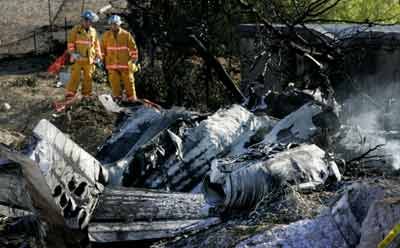 | Firefighters survey the wreckage of a plane that crashed in Carlsbad, Calif., Tuesday, Jan. 24. The twin-engine plane crashed and burst into flames while landing at McClellan-Palomar Airport, Tuesday, killing all four people on board, the Federal Aviation Administration said. (AP Photo/Sandy Huffaker) |
Spotting the fire engine was a little tricky for Engineer Pete McKenzie. He had to ensure the apparatus was positioned close enough to initiate an efficient fire attack, but also had to keep it far enough from the fires around them and the jet fuel flowing downhill from the plane wreckage in his crew’s direction. McKenzie ended up parking the engine in the middle of the street.
When Vance and his crew arrived, a one-person aircraft rescue firefighting unit (ARFF) was already on scene fighting the aircraft fire with firefighting agent, Vance said. "(The plane) was so involved in flames that the fire wasn’t going to spread anyway,” he said. Vance and his crew focused their efforts on extinguishing the blaze in front of the hydrant.
“From the time we got there we were trying get a flow of water going,” Vance said. “The concern is you need to get a water source quickly.”
Firefighter Roark Griffin extinguished the flames blocking the fire hydrant with a 500-gallon water supply on their engine, he said. The fire needed to be put down quickly because the water tank would have lasted no more than four minutes based on the size of hose used, he said.
Following that, McKenzie was able to connect to the hydrant and secure steady water supply for the additional crews arriving at the scene.
After the blaze in front of the fire hydrant was extinguished, firefighters began attacking the vehicle fire and debris fires around the storage area before attacking the fire inside the storage facility.
“We had three hoses in place and used two circular saws and a chainsaw” on the storage facility, Vance said.
The storage facility was a wood-frame stucco covered building with a metal roof and roll-up garage doors. Firefighters made cuts on seven of the garage doors and were able to open the locks and manually open the other three units. Four of the units were involved — two moderately and two lightly, Vance said.
According to the dispatch record, two fire engines, a rescue truck, a paramedic ambulance, a battalion chief and the airport rescue fire truck were called to the scene on the first alarm. The second alarm brought units from nearby departments in San Marcos, Encinitas and Vista, including a division chief, a battalion chief, four fire engines, two aerial ladder truck companies, an incident support unit and an additional paramedic ambulance.
Vance and his crew were first on scene at 6:40 a.m. and the fires were brought under control by 7:14 a.m.
The Carlsbad Fire Department has responded to a few plane crashes prior to this.
“The vast majority of the time we’re alerted the plane lands safely or there isn’t any life-risking incident,” he said. Each incident had the potential for a serious emergency, he said, but most have ended without loss of life. The two exceptions were a mid-air collision a few years back and a plane crash that killed two people approximately 10 years ago.