

By Battalion Chief Paul Vanlook
Gavere, Belgium, Fire Department
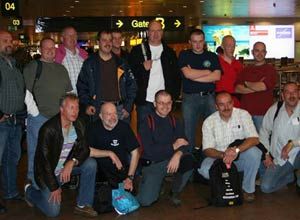 Photo Belgian Fire Observers The group pose for a final photo before leaving Houston to head back home. |
For the past 12 years, a group of European firefighters have visited a U.S. fire department to find out how things are done differently here. And last week, it Houston’s turn to welcome us.
The seven-day visit was the 27th trip arranged by the Belgian Fire Observers, a non-profit organization. It saw 14 Belgian and Dutch firefighters riding along with their U.S. colleagues, observing their way of operation, taking a closer look at their equipment, studying their methods of response, and sharing experiences as to how things differ — or are even similar — back in Europe. Since we began the initiative, different people have taken part in each trip. So far, more than 250 firefighters have been given the opportunity to travel.
Some of the participating firefighters are from big city departments, while others hail from small, local communities. But we were all are eager to see and observe how things are done in Houston. During the visit, we were able to go behind the scenes of a 911-dispatch center, observe the differences in training methods at a training facility and see how fleet management is carried out by the HFD.
Management differences
Major differences we observed were mostly in the field of management. It seemed to us that most U.S. departments have small fire stations, but that are spread over the territory the department protects. The capital city of Belgium, Brussels, has a fire station that houses 88 pieces of equipment.
We were also impressed at the high regard firefighters are held in here. The daily shopping runs where the fire apparatus can be used showed us the interaction between firefighters and the local population. We even witnessed somebody bringing a cake to the station.
And speaking of food — man, these firefighters can cook. And eat. We kept thinking that there was another crew coming over, but it was only for the guys in the station.
The high volume of calls taken in the busy stations was also a surprise, but maybe this is because of all the medical runs departments in the United States have to do. It’s uncommon in Belgium for the fire department to be dispatched for every medical call. A small fire crew will only be dispatched when there is real suspicion that the ambulance crew will have problems with entering the premises.
Traffic incident responses
Another area of surprise was the fact U.S. departments use a truck to go to a traffic incident. Most Belgian fire departments have small vehicles (the size of your battalion chiefs’ cars) mounted with all the power tools that can go to the traffic incident for extrication. Meanwhile, the nearest hospital will dispatch a Medical Urgency Unit, which has a doctor on board.
Our previous trips have seen members go to San Diego, Jacksonville, Fla., San Jose, Calif., Phoenix, Dallas, Atlanta, Washington DC & Fairfax County; Charleston, S.C., Orange County, Calif., Miami Dade, Fresno, Calif., Austin, Richmond, Va., Indianapolis, Norfolk, Va., Reno, Nev., Corpus Christi, Texas, Oakland, Calif., and Mobile, Ala.
For next year’s trip, we have already made arrangements with Oklahoma City and Mesa, Ariz.
It all started in Belgium but now we have groupmembers that come from Holland too.
To keep the costs down, all of the trip costs are paid by the participants with no department subsidies. We sleep in the fire stations during our stay with the fire department, allowing us to truly observe how the fire department functions.
Our experience during the past 12 years is that we all belong to the same firefighter family. Everywhere we have gone, we have been welcomed. Some real friendships were born out of our encounters. It feels great to have friends on the other side of the ocean. We are always looking forward to the next trip.
All of our stories are published on our Web site, Fireobservers.org, where you can find all the information you need to contact us or you can e-mail info@fireobservers.org. We’d be delighted to hear from departments interested in being our next host.