

By Jamie Thompson
FireRescue1 News Editor
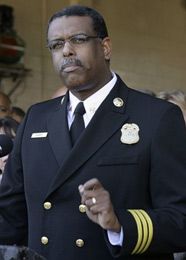 AP Photo/Nick Ut Douglas Barry speaks during a news conference in December 2006. |
There were likely few less desirable jobs in the fire industry than that of Los Angeles Fire Department Chief just over 12 months ago.
The LAFD had been subjected to a string of lawsuits alleging sexual and racial harassment, and union relations were seriously strained. The turmoil crested in December 2006 when then-Chief William Bamattre resigned amid a furor over a black firefighter, Tennie Pierce, being served spaghetti mixed with dog food.
Fortunately for the LAFD, Bamattre’s replacement, Douglas Barry, has helped to steady the ship — even if he was initially reluctant to take on the job.
Barry was a 31-year veteran of the LAFD, having served as firefighter, engineer, captain, battalion chief, chief of staff and assistant chief. The chief’s position seemed the logical next step, but at the time of Bamattre’s resignation in December 2006, Barry had already scheduled his retirement for just several months later.
And, in Barry’s own words, “I’ve always preferred to working behind the scenes, not upfront where the fire chief is and very visible.”
But as Barry began his work as interim chief, seeing firsthand the huge challenges the department faced, the sense of loyalty and pride that goes with more than three decades on service began to have an effect on him.
Change needed
In addition, his efforts in rallying the beleaguered department seemed to be having an effect. Also — and perhaps most importantly — for the first time in what seemed like years for many in the city, everyone seemed to agree change was needed, from union leaders to local politicians.
“Many departments and groups had come to all work together to resolve these issues and I saw the opportunity was there to really get some things done that the fire department had been trying to do for a long time,” Barry said. “The environment was perfect for it; people seemed to have confidence in the city.”
Barry’s retirement plans are now on hold. Now that he’s begun to initiate reforms and cultural change within the department, he has strong sense of seeing those through.
“I worked on getting reforms in place and when it came to deciding whether I would become the full-time chief, we were making progress with things, even though it was slow,” he said. “I decided that I wanted to finish that.”
One of Barry’s first actions that won favor with department personnel and unions alike was the decision to meet his members across the city face-to-face. Shortly after being appointed interim chief, he set out a schedule to visit the department’s more than 100 work locations, a figure he is still working his way through.
He said his aim is to “effectively communicate the expectations of the department and myself as the fire chief.” The decision to go for the personal touch, rather than my memos or e-mails, he said, stems from his experiences as a supervisor, where he found the most effective way to communicate to people was “face-to-face.”
“It has also been the chance to listen to what they thought the department should be doing, and I learned a lot from the members,” Barry said. “I’m not only talking to the people but I’m also listening to what they have to say.”
Upon his appointment, Barry admitted that his biggest task was to put an end to the “frat-house culture,” as local media described it, that seemingly allowed hazing and discrimination to spiral out of control.
However, he insists the issues within the LAFD are not as bad as they have been painted in some quarters.
Reflection on society
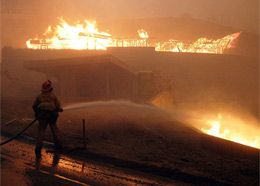 Photo Mike Meadows An LAFD firefighter uses a hose line on flames during the Corral Brush Fire near Malibu in November. |
The LAFD, or any large department or organization, is a reflection on society, according to Barry. In addition, the well-documented issues have been given more exposure because of the size and stature of the LAFD, he added.
“Some of these things have happened at other departments,” Barry said. “But because we are a large department and we are in the limelight, a lot of it gets more attention. But similar things do happen in other departments as well; we’re all a reflection of society.”
In his own rise through the ranks, Barry, who is black, said he never experienced any overt racism, before adding, “Maybe I’m just a very fortunate person.”
Of course, it hasn’t just been internal departmental affairs that have consumed Barry’s time and efforts. The SoCal wildfires toward the end of last year posed their own particular challenges to the city, namely staffing.
Barry said that the LAFD’s main role was providing resources, sending roughly 30 companies to assist other fire departments.
“It was a big challenge for us insofar as sending the resources that were needed, but to make sure we had enough resources here in case something happened in the city,” he said.
As for tests that lie ahead, Barry identifies budgetary issues as the biggest challenge facing not only his own department but those nationwide.
It’s the constant headache faced by any chief, he said, of “being asked to do more and more but with less and less money.”
“Thirty years ago, it was firefighting with some EMS and little bit of fire prevention,” he said. “But now it’s so much more than that. Firefighters are being pushed to have so many new skills in different areas and be proficient in all these various fields.”
Now 12 months in as chief, it has been a steep learning curve for Barry in finding out what makes a good chief.
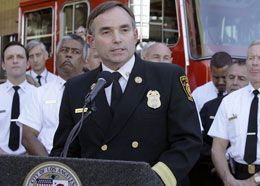 AP Photo/Nick Ut William Bamattre resigned in December 2006. |
For him, there are two things involved in being an effective leader: building the trust of your people and consistency.
“You need to be consistent, people need to know where they stand and what to expect from you,” he said.
“You also need to build trust and provide a vision and the direction the department is going in — but it has to be shared.”
Barry looks back on the first year with both pride and honesty.
“We’ve had everyone working together, pulling together, and progress is being made,” he said.
“Perhaps my only disappointment is that the progress hasn’t been fast enough in some ways.”
Related Resources: LAFD veteran sworn in as city’s first black chief |