

By Jamie Thompson
FireRescue1 Editor
DAYTON, Ohio — With firefighters facing twice the average risk of dying from certain types of cancer, the importance of wearing full PPE at all times on the fireground should be a given.
And while it’s true that today’s gear offers higher levels of design and performance technology, that’s only the start.
What about protecting the very thing that protects the firefighters — the turnout gear itself?
A regular maintenance and cleaning program is vital to the health of the gear and ultimately firefighters, something that led to a revision of NFPA 1851 which took effect about 18 months ago.
The standard for the selection, care, and maintenance of structural fire fighting protective clothing makes a number of significant revisions aiming to improve the management of firefighter turnout clothing through more rigorous and defined testing requirements.
Fire departments have essentially two choices when it comes to the care of turnout gear — either in-house or through independent service providers (ISPs).
One of the most innovative options celebrates its 10th anniversary this year, having been introduced even before the first edition of NFPA 1851 was introduced.
Lion Apparel’s TotalCare service was adopted by the London Fire Brigade in 1999. Lion not only supplied turnout gear to the department’s firefighters, but also took charge of a high-tech cleaning, inspection and repair program.
Cleaning process
The unique service, which has since been contracted to other departments in Europe, Australia and most recently the Chicago Fire Department in 2006, sees the supplied turnout gear regularly cleaned in state-of-the-art facilities before undergoing advanced inspection techniques and repairs.
Vicki Smith, who oversaw the introduction of the service at the London Fire Brigade, said it is vital to get the message out that appropriate cleaning of turnout gear is tied to the much-documented health issues firefighters face.
“Studies are appearing to demonstrate that particles are getting into firefighters’ systems, and it appears to lead to certain types of cancers,” said the director of marketing for Lion TotalCare. “It is known that certain types of cancers are more prevalent amongst the firefighter population.
“Toxins from fire scenes can collect in protective gear and be absorbed though the pores of the body. And with heart attacks being the biggest killers of firefighters, there does seem to be a tie between the absorption of these particles and those firefighters with prior dispositions for heart conditions as well.”
These toxic contaminants, Smith said, are also being carried back to the station, causing secondary exposure through the handling of contaminated gear.
“This also brings about public health concerns,” Smith said. “Firefighters need to make sure that they are not exposing other people outside of the fire service to these contaminants while they’re doing outreach programs as well as the fact you can have schoolchildren going to the fire stations for visits on a regular basis.”
But the benefits of a regular cleaning and care program are not limited to health; poor maintenance can reduce the performance of the protective equipment, causing it to reflect less radiant heat.
Related Video https://flashovertv.firerescue1.com/Clip.aspx?key=FDB5CC4EE1AFE401 |
| Clip from Lion TotalCare explains how to check gear. |
Unburned fuels
Specifically, petroleum hydrocarbons — unburned fuels — can become flammable if exposed to intense heat, so they must be removed from gear regularly.
“Turnout gear is only certified to be compliant when it reaches the end of the factory,” Smith said.
“From that moment on, manufacturers can no longer control what happens to that gear. I don’t want to say it’s no longer compliant, but the safest it’s going to be is when it’s at the end of the factory line.
“We feel it’s our responsibility as a turnout gear manufacturer to assist fire departments in keeping the gear we supply up to optimum level that we can.”
Furthermore, the provision of proper care has one other additional benefit — it can help make equipment last longer, something particularly important in today’s economic climate.
However, despite the increased awareness of the importance of keeping gear well maintained and clean, Smith estimates only about 10 percent of departments in the United States have adequate programs in place.
Lion’s creation of TotalCare came about when a law was passed in the UK in the late 1990s requiring equal levels of protection in the protective clothing or equipment employees were required to wear.
“The London Fire Brigade looked at that law and started to look at how it was possible to ensure, considering gear can be different ages, that everyone is being protected equally,” Smith said. “Their idea was annual maintenance, where it was cleaned, inspected and repaired if needed.
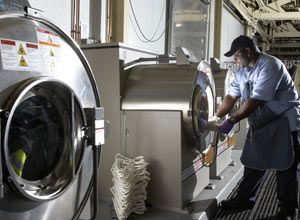 Photo courtesy of TotalCare A worker at the Chicago facility begins the cleaning process for turnouts belonging to the city’s firefighters. |
“They thought if you had it cleaned, inspected and repaired, then you could make sure everybody had fit-for-duty gear.”
Life cycle tracking
With Lion thinking along similar lines at the time, the TotalCare concept was born. In addition to cleaning and maintenance, the company also offered life cycle tracking of turnouts, with electronic tags allowing Lion staff to keep computer records of cleaning and repairs.
Lion has since launched additional ISP facilities in Dallas, Houston and Philadelphia, offering programs for any brand of turnout gear, as well as the Chicago facility, which was built specifically for the department and is based on the London model.
Lion TotalCare is now the biggest cleaning service used by fire departments in the United States.
Along with the regular ISP services, it also offers emergency response programs, where replacement gear can be sent to departments to temporarily replace any that has been knocked out of service by major incidents. Rental programs also cover the cleaning cycles of regular turnouts.
But it was the London TotalCare model that the Chicago Department adopted when it finally updated from its traditional uniform of three-quarter-length coats and hip-high rubber boots, which left groin and thigh areas unprotected.
Tracking PPE
TotalCare was part of a $10 million contract the department signed with the Dayton, Ohio-based company to provide both the new turnout gear and a regular advanced cleaning, inspection and maintenance program.
Each item of PPE managed and maintained within the program carries a unique
2-D barcode, enabling all cleaning and maintenance actions associated with that item to be monitored.
It also ensures items can be physically tracked; TotalCare drivers picking up gear from firehouses — with pickup dates scheduled around firefighter furloughs — scan the barcode on each item collected.
 I think that for fire departments that have mature maintenance programs, we should be able to see a downward trend in injury rates. I think that for fire departments that have mature maintenance programs, we should be able to see a downward trend in injury rates.  | ||
| — Vicki Smith, TotalCare director of marketing | ||
Items are taken to the city’s 16,000-square-foot TotalCare Center, where it undergoes cleaning, inspection and repair, with the firefighter, asset and event detail all recorded, giving the department the data required by NFPA 1851.
Smith said the ability to extensively track and monitor the performance of gear — something also offered at the other TotalCare sites — can be vital in helping departments take note of gear trends and wear patterns.
“We can give them the sort of information they need to develop any future specifications,” she said.
In addition, the company is working on conducting research studies with departments that have had programs in place for a number a years. Smith said it will help highlight their importance in relation to the performance and durability of turnout gear.
“I think that for fire departments that have mature maintenance programs, we should be able to see a downward trend in injury rates,” she said.
“I think most are aware of needing to maintain turnout gear, but I don’t think the significance of it is fully understood by everyone in the fire service.”
- For more information on TotalCare, visit LionTotalCare.com.