

By Elise Kleeman
San Bernardino County Sun
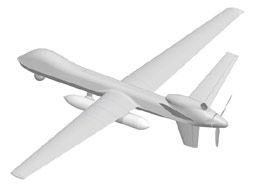 IMAGE BY NOAA NASA’s Ikhana is being used to observe wildfire behavior. |
SANTA BARBARA, Calif. — The newest wildfire-fighting technology this year won’t be on the ground, but overhead.
Meet Ikhana, a plane with a 66-foot wingspan and no pilot on board.
In a joint project of NASA and the U.S. Forest Service, this Predator B unmanned vehicle is taking to the skies in demonstration of a new generation of firefighting tools.
“It’s not like your everyday remotely piloted toy. It’s much closer to a real military-type plane,” said Brent Cobleigh, Ikhana’s project manager at NASA’s Dryden Flight Research Center.
With the help of an on-board infrared camera and the ability to transmit real-time images to command stations on the ground, one day unmanned planes similar to or smaller than Ikhana could allow firefighters unprecedented insight into the boundaries and movements of treacherous wildfires.
“A lot of times, especially in rough terrain, the incident command don’t exactly know where the fire is, with the smoke in place,” said Everett Hinkley, the coordinator of the remote-sensing program for the Forest Service.
“It’s very important to have critical knowledge of where the fire is so you can deploy the resources as quickly as possible and also not put the people that are on the ground in harm’s way,” he said.
On Aug. 16, Ikhana took off on its maiden scientific flight, soaring for 10 hours over California wildfires including the tenacious Zaca fire in Santa Barbara County.
On Wednesday, it will leave on a 20-hour journey, flying nonstop from Edwards Air Force Base to observe wildfires in Idaho, Montana and Wyoming. Later in the fire season, it will likely be used to survey the Santa Ana-driven fires of Southern California.
Ikhana remains, though, just a demonstration. With a price tag of at least $6 million, using large drones for firefighting is “a little far out on the horizon, five to 10 years,” Hinkley said.
Smaller unmanned planes could find their way onto the front lines of fires in the next year or two. Hinkley said with about a $50,000 price tag, they could possibly provide savings over helicopters costing $5,000 to $15,000 a day.
“I think it would be great,” said Tony Marrone, Los Angeles County Air Operations Chief. “We’re only a pair of human eyes and we can’t see through the smoke.”
Although helicopters with infrared cameras are now used to spot fire boundaries, he said, “it’s hard to take our helicopters out of the water-dropping role.”
Officials said that Federal Aviation Administration regulations restricting the flight of unmanned planes in national airspace also need to be overcome.
“They’ve been asking for three days’ notice in where we want to go. The fires that start today, we can’t go to tomorrow,” Cobleigh said.
He estimated it would take between five and 10 years for the FAA to allow the drones to take off on a moment’s notice like regular planes.
Copyright 2007 MediaNews Group, Inc.
All Rights Reserved