

|
|
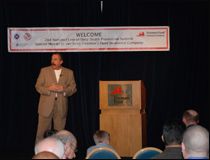
NOVATO, Calif. — Efforts to reduce firefighter fatalities were stepped up at the weekend as fire service leaders met to refine the national safety blueprint.
The second National Line-of-Duty Death Prevention Summit in Novato, Calif., attracted more than 200 chiefs, firefighters and experts from related fields.
Over the course of the two days, the 16 Firefighter Life Safety Initiatives drawn up at the inaugural summit in Tampa two years ago were discussed to help make improvements to them.
For Charlie Dickinson, acting U.S. fire administrator, the aim of the summit, and the initiatives themselves, were simple.
“This is not a mystery we are involved in,” he said in the opening ceremony.
“This is not about what we should do or can do, it’s what we need to do.
“Most of what we are going to share I expect isn’t going to be new news. What it’s going to be isn’t reshuffling the deck, but reshuffling our energy.”
‘Gaining acceptance’
Richard Anderson, program director of the Firefighter Life Safety Initiatives, told delegates the project had gained good momentum since its launch by the National Fallen Firefighters Foundation and Everyone Goes Home in 2004.
“It’s rapidly gaining acceptance across the land,” he said, “in large part because of your hard work and commitment.”
The summit at the Fireman’s Fund Insurance Company headquarters featured six breakout discussion groups — health and wellness, prevention, structural, wildfire, training/research, and vehicle — that each covered several of the 16 initiatives.
The draft recommendations and ideas from the groups will soon be presented in a new, updated Firefighter Life Safety Initiatives document.
The recent death of Baltimore cadet Racheal Wilson in a live-fire exercise added an even greater sense of importance to the training/research group.
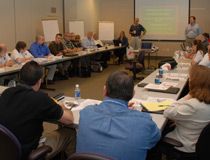 The vehicle safety group produced a range of recommendations. |
Group moderator Steven Edwards, director of the Maryland Fire and Rescue Institute of the University of Maryland, called the death one of the most horrendous training-related fatalities there had ever been.
But he told group members that the training sector had the best opportunity of all areas to reduce deaths.
More than a dozen firefighters on average die annually in training.
Full control
“When you look at the other factors in firefighter fatalities, there are many contributing factors that come into it, such as building structures and other vehicle traffic,” Edwards said.
“But in training, we have 100 percent control over it. If we are going to be successful anywhere, we have the best opportunity in reducing training fatalities and training injuries.
“We really have a unique opportunity (in training) both in terms of controlling our environment and making an impact on that person to help him or her in their entire career.”
With vehicle accidents one of the biggest killers of firefighters, the vehicle discussion group decided on several related key points to reinforce the strength of some of the Firefighter Life Safety Initiatives.
They included:
- Sponsor an effort to deliver national best practices for emergency and non-emergency responses.
- Make safety a core value by implementing a pledge of support for LACK (Leadership, Accountability, Communication and Knowledge).
- Build a bridge between end users and manufacturers of apparatus to improve handling training.
Driver safety
Bill Jenaway, executive vice president of VFIS, a provider of insurance and risk management services to Fire and EMS agencies, stressed the need for more to be done in the driving and vehicle sector of the fire service.
“There needs to be a comprehensive approach to driver training development,” he said.
“There needs to be more than the initial driver training course. There’s got to be something that requires basic certification and periodic refresher training.”
FDNY firefighter Mike Wilbur, who serves on the department’s apparatus purchasing committee, agreed more work was needed in the field.
“There’s no mechanism in place to update existing apparatus to take account of safety improvements,” he said.
“You could get a new vehicle in 2007, but in 2010 someone could come up with a whiz-bang safety idea for apparatus.
“But that apparatus bought in 2007 could be in service for 10 to 15 years, and not have that important safety device that could save firefighter lives.”
Draft recommendations from the 2007 National Line-of-Duty Death Prevention Summit