

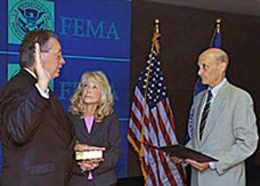
 Photo courtesy of USFA U.S. Department of Homeland Security Secretary Michael Chertoff swears in Greg Cade as U.S. Fire Administrator. Cade’s wife, Deborah, holds the family bible during the ceremony in Washington. |
Reducing the number of line-of-duty deaths by 50 percent in 10 years was one of former Fire Administrator David Paulison’s most ambitious targets.
His successor, Greg Cade, is vowing to do what he can to ensure that the goal is achieved.
The country’s new fire administrator said that one of his top priorities is keeping the pledge made in 2004 on track.
Cade, who has nearly 40 years experience in the fire service, was officially sworn in as the head of the administration in July.
In an exclusive interview with FireRescue1, he outlined what he hopes to accomplish in the role over the next 18 months – and hopefully beyond.
As a presidential appointment, he will be in the position for at least the rest of the Bush administration, which will terminate in January 2009. The next president will then decide whether Cade remains in the role.
‘Realistic’ aims
Because of the potential time constraints, Cade said he has to remain “realistic” in setting his agenda for the next year-and-a-half.
The line-of-duty death goal set by Cade’s predecessor figures prominently.
“I want to determine where we are in that process and what programs I can continue to push and support to bring that commitment to fruition,” Cade said.
So far, 2007 is shaping up to be a deadly year, with more than 70 firefighters killed in the line-of-duty in the first seven months.
If the fatalities continue at the same rate, 2007 will eclipse the death rates seen in recent years.
Cade said that he hopes the high number is a blip in statistical terms, but pledged to maintain efforts to reduce firefighter fatalities.
“We are the first line of defense in communities, whatever the issue, but we can’t do that if there are no firefighters,” he said.
“To me, it’s a critical issue to keep firefighters safe and healthy.”
Data center
As part of his drive to improve firefighter safety, Cade said he wants to look at ways to improve the Fire Administration’s National Fire Data Center.
The center has tracked and conducted analysis of firefighter fatalities for more than two decades. It was created to track trends and find solutions to reduce the number of deaths in the future.
While it has proved a good resource in bringing together statistics over long periods of time, said Cade, improvements can still be made.
“It’s not easy to access in a timely manner, and the data you can get is generally from a couple of years ago,” Cade said.
He added that he hopes to speed up the processing of information to enable chiefs and departments to access relevant material as quickly as possible.
“We need to figure out how to make it a more interactive, Web-based system,” Cade said.
“Of course there’s great value in having a long-term statistical system, but as a fire chief I’d want to know what happened last week, what happened yesterday.”
The third priority, Cade said, is to get the fire departments to lead the way in teaching communities and other responders the Incident Command System. With the fire service’s extensive use of the system, it is vital that departments pass on their experience to others.
Katrina support
Before his appointment as U.S. Fire Administrator, Cade was fire chief/emergency services coordinator of the City of Virginia Beach (Va.) Fire Department. Coordinating the response to Hurricane Bonnie in 1998 was among his first tasks. He also supported the New Orleans Fire Department after Katrina.
In addition to his duties at local level, Cade has also served on the National Urban Search and Rescue Team Advisory Board and as a sponsoring agency chief for Virginia Task Force 2, as well as receiving national recognition for his involvement in municipal government.
He said disaster response efforts have to be carried out in a cohesive manner – something that still does not happen in too many areas of the country.
“The Incident Command System is something we are used to using every day, while the other agencies aren’t,” he said. “So it’s a natural fit for the fire service to take the lead.”
While Cade is unsure how long his latest role will last, he is determined to make his tenure a successful one, and he’s excited to have the opportunity to work at the federal level for the fire service.
“I’ve been in the fire service for nearly 40 years and have loved every day of it,” he said. “Hopefully, this is the chance to give something back to the profession I absolutely love.”
| Related resources: USFA fatalities and statisticsDeath prevention summit reinforces Firefighter Life Safety Initiatives |