

By Sara Kugler
The Associated Press
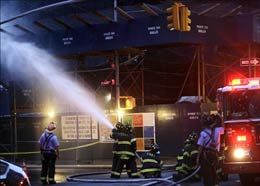 AP Photo/Seth Wenig Firefighters spray water on smoldering debris that fell off the Deutsche Bank building, Saturday. Slideshow: Deutsche Bank fire |
NEW YORK — Firefighters who battled a deadly blaze in a half-dismantled skyscraper next to the World Trade Center site lacked a basic tool — the building’s water supply system was busted.
Fire marshals discovered the standpipe problem after two firefighters died inside the former Deutsche Bank tower on Saturday. Both men got lost on the 14th floor as their air tanks ran out and inhaled smoke.
Investigators later found a chunk of the standpipe detached and lying on the basement floor, the city said Monday.
The building has been empty since it was damaged by falling wreckage during the terrorist attack on World Trade Center six years ago, and it was being dismantled floor by floor. Once 41 stories, it stood at 26 when the fire broke out.
The city said fire investigators had determined the blaze began in an area on the 17th floor where workers stopped for decontamination. Dust and debris blown into the bank building when the trade center towers collapsed contaminated it with asbestos, lead and even bits of human remains, making the deconstruction work difficult and dangerous.
Fire marshals spoke to eyewitnesses who said workers smoked and put out cigarettes in the area, which was near the construction elevator used to access the floor.
The city said the area also had electrical equipment, including water heaters for decontamination showers.
“At this point we do not know the cause of the fire, but full and comprehensive investigations are under way,” Mayor Michael Bloomberg said. “We are using every possible resource to find out how this fire started and what went wrong.”
The mayor said separate investigations were launched to determine how the fire started and what led to the firefighters’ deaths.
Officials also were trying to sort out the confusion about who was responsible for the standpipe and other issues.
Private contractors are working on the state-owned building, while multiple local, state and federal agencies have a hand in the decontamination and deconstruction. The effort was described by the city as “unusually complex.”
The skyscraper’s owner, the Lower Manhattan Development Corp., bought the tower three years ago and took over the removal project. During demolition, the city Department of Buildings issued a separate permit for each floor before it could be taken down.
With each floor permit, the Department of Buildings visually inspected the valves and caps for the standpipe in the area, but the inspections did not include testing the water flow. The last permit was as recent as July 31, for the dismantling of the 26th floor.
In working buildings, the fire department is responsible for checking the water flow in standpipes every five years, according to fire department spokesman Jim Long. Building owners typically maintain them in between.
The city could not say on Monday when the water network had last been tested, but the fire department said the building had been issued at least one other violation related to standpipe problems.
The troubled building had been plagued with citations issued by building inspectors, including debris falling from the building and excessive amounts of combustible debris and plywood stacked around the site.
The deaths of firefighters Joseph Graffagnino and Robert Beddia also raised questions about why emergency responders would enter an empty building that was long ago condemned.
The president of the Uniformed Fire Officers Association, Jack McDonnell, said there was no other choice than to send firefighters into the building.
“It never could have been contained from the outside,” he said. “The building could have collapsed, endangering lives and property.”