

By Christopher Leonard
The Associated Press
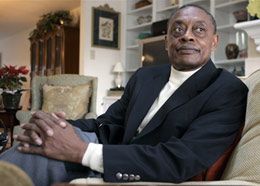 AP Photo/Jeff Roberson Former Fire Chief Sherman George poses for a photo in his home Wednesday, in St. Louis. |
ST. LOUIS — Few brotherhoods are as strong as the one among firefighters, who depend on one another just to stay alive. But powerful racial tensions have divided the St. Louis Fire Department and spilled over recently to City Hall.
In October, the city’s white mayor, Francis Slay, demoted black Fire Chief Sherman George after a three-year dispute over the firefighter promotion exam.
Since then, the FBI has investigated two incidents inside engine houses that were reported as possible hate crimes, one involving a stuffed monkey hung by the neck, the other a noose tied around a cracker box.
The FBI concluded that neither case was racially motivated, and neither amounted to a federal crime.
But coupled with the chief’s demotion, and his replacement by a white firefighter, the incidents have stirred an outcry from the city’s black community. There have been rallies at City Hall, an effort to recall Slay, and a boycott of the city that is making a convention of black engineers consider moving the event elsewhere.
Firefighters, politicians and preachers have been drawn into the dispute, with the opposing sides describing the monkey and noose incidents in starkly different terms.
“The good white folks say it’s a prank,” said retired Battalion Chief Robert Grady, who is black. “To a black guy, that’s a death threat.”
The mayor said he is trying to bridge a long-standing divide in the department that is institutionalized, the department’s union is largely dominated by white members. It was a blacks-only group within the department, the Firefighter’s Institute for Racial Equality, that raised the complaints that led to the FBI investigation.
The roughly 700-member firefighting force is 56 percent white and 43 percent black, while the city of 347,000 is about 50 percent black and 45 percent white.
“The racial tension seems to really rise to a high level every time the promotion issue comes up,” said the mayor, who is in the middle of his second four-year term. “This is something that has been going on for at least the 20 years while I’ve been in city government.”
FBI agent John Gillies said the monkey had been found at a fire scene and brought back to the engine house, where a firefighter hung it from a strap around its waist to dry. It remained there for weeks until someone removed the stuffed animal in December and rehung it by the neck, Gillies said.
The noose around the cracker box was a misguided attempt to make light of the monkey incident, Gillies said. The firefighter who put the noose around the box was a minority, but not black, according to the FBI agent.
At issue in George’s demotion was a test used to determine which firefighters are promoted. George insisted the test was inadequate because it focused too much on superficial questions that didn’t demonstrate the kind of skills needed in a real fire.
In 2004, the black firefighters organization sued over the tests, claiming the process discriminated against blacks. Over the next three years, George put a freeze on all promotions. Of the 28 candidates on the promotion list based on their exam scores, only four were black, the former chief said.
“It’s a matter of principle,” George said. “I stood for what I believe.”
The mayor’s office argued that holding up the promotions violated the city’s charter, which takes hiring decisions away from the fire chief to reduce cronyism.
When City Hall ordered George to make the promotions this fall, he refused and was demoted. Soon after, he retired and filed a complaint with the U.S. Equal Opportunity Employment Commission.
Chris Molitor, president of the firefighters union, said the chief’s refusal to approve any promotions put a strain on the department, burdening some firefighters with leadership duties.
“There’s a lot of extra work with doing the job above you, and everyone was doing it with no extra compensation on top of it,” Molitor said.
George, the city’s first black chief, himself won his first promotion only because of a federal court order in 1978 that found the department’s tests for promotions discriminated against blacks. George, 63, and other black veterans of the department say racism hindered their rise at every step.
“The fire department was a country club for white folks,” said retired Capt. Baby Webber, who is black. “Then the black folks started coming in and breaking up their country club.”
The mayor does not see the recall petition against him as a political threat, said Slay’s chief of staff, Jeff Rainford. Organizers said Wednesday they had collected just 7,000 of the 43,000 signatures necessary for a recall.
The mayor said his director of public safety is drawing up plans to create a committee with members from both the union and the black firefighters organization that could establish new policies for the department.
“I think the vast majority of the people in this city, both black and white, are interested in moving this city forward,” Slay said.
The Associated Press