

By Emily Bregel
Chattanooga Times Free Press (Tennessee)
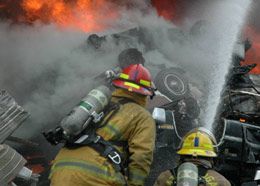 Photo Bruce Garner Chattanooga firefighters tackle a blaze at a scrapyard in March last year. |
CHATTANOOGA, Tenn. — For 52-year-old Ken Moses, three decades of battling fires has worn him down.
“This is not an old man’s game,” said the captain of fire Station 8 in Chattanooga. “That’s 80 pounds of gear I wear every day. We’re constantly going in where people (are) running out. The house fires, the building fires — it takes a toll on a man.”
But Capt. Moses said when he officially retires from the fire department on Jan. 31, he will have left a legacy to the younger generation of firefighters.
“Here at my station, we’re constantly training people. ... As a captain, I’ve been training the younger guys here to be able to step up and take my job when it becomes available to them,” he said.
The transfer of knowledge to a new generation of employees has become crucial for public institutions, as the oldest members of the boomer generation hit 62 this year, and many even in their early 50s become eligible for retirement packages.
Those in the baby boomer generation — born between 1946 and 1964 — total about 78 million, and many work for public employers such as fire departments, the school system and the Tennessee Valley Authority.
Public sector employers here are grappling with an expected drain of experienced workers and their institutional knowledge, as well as bracing for massive benefits payouts.
Assist planning
The Hamilton County school system is asking employees to give as much notice as possible before they retire to assist planning, said Connie Atkins, assistant superintendent of human resources.
Typically, about 100 school employees retire each year, out of about 6,300 employees, Mrs. Atkins said.
Looking ahead, more than 600 employees in the school system already have at least 25 years of experience, including 74 of 191 who are in administrative positions such as principals and assistant principals, she said.
School system employees are eligible for full retirement at age 60, with at least five years’ employment, or after 30 years of work regardless of age. Early retirement is offered at age 55. That means many relatively young employees are eligible to retire soon, Mrs. Atkins said.
“The boomers, they tended more to stay with one employer, so those people if they started to work right out of college, they’ll be 52 (years old) with 30 years of service,” she said. “We know those people between now and the next five to seven or eight years, they definitely are going to retire. ... That’s a lot of people to anticipate leaving (the) system over five years.”
Jean Trohanis, 56, is one of them. After 34 years in Hamilton County schools she said she gave her notice before Christmas that she will be retiring in June.
The principal at Thrasher Elementary said she’s not concerned about the school system’s ability to replace experienced administrators and pointed to programs such as the Public Education Foundation’s leadership training initiatives.
“The new principals actually have a lot more training in leadership than what we had,” she said.
Knowledge transfer
At TVA, the federal utility replaced a third of its work force between 2000 and 2005, with a focus on the transfer of knowledge from older to newer employees, said Keith Fogleman, senior manager of labor relations.
He said TVA is projecting that 15 percent to 20 percent of its work force of more than 11,800 will retire in the next three years.
Particularly during the building of the Watts Bar Unit 2 reactor, construction workers and electricians will be in high demand, he said. Much of that work force is baby boomers who are approaching retirement, so TVA is working with local and state-level labor unions on recruitment, he said.
“We’re trying to make sure that work force is going to be ready to meet the need going forward because there’s going to be a lot of construction in the southeastern United States,” he said.
Firefighters and police officers can retire after 25 years of service and must leave before age 65, said Chattanooga Fire Department Deputy Chief Lamar Flint.
In 2000, the Chattanooga Fire Department lost more than 60 people when an incentive plan to give extra benefits to officers who retire early went into effect. As a result of those departures, more than half of the fire department is under age 35, he said.
“We had a pretty mass exodus at that time, but since that time the numbers have leveled off,” he said.
After 28 years on the police force, Sgt. Lee Stewart will hang up his holster and pick up a bat instead.
The 56-year-old said that in his retirement years he will focus on coaching youth baseball and volunteering at his church.
“I’ve worked just about my whole life,” said Sgt. Stewart, 56. “I don’t know what I’m going to do. ... Hopefully not too many ‘honey-dos.’”
Chief Flint said the fire department has held academies to replenish the ranks. The academies focus on sharing knowledge between experienced, older firefighters and the new recruits.
“Captains and lieutenants train daily with the subordinates, administratively and operationally,” he said.
The city police department has implemented a program to recruit older, more experienced cadets who already have worked as police officers, said training supervisor Lt. Stan Allen.
“We can reduce the amount of time that they spend in the academy and the amount of time they spend in field training,” he said. “They’re way ahead of the game.”
Pension promises
Public employees often have generous benefits packages to compensate for modest salaries, and across the country states are facing a $2.73 trillion bill for pension, health care and other retirement benefits over the next three decades, according to a December report by the Pew Charitable Trusts’ Center on the States.
Most pension funds are in good shape: In Tennessee more than 98 percent of the pension liability is funded, but like most other states, Tennessee has not yet put aside any of the $2.3 billion it will owe public employees in health and other nonpension benefits.
Locally, Hamilton County and Chattanooga this year began setting aside money to pay for post-retirement benefits for employees.
The estimated liability for those benefits is up to $228 million, an expense that will require the city to put an additional $8 million to $13 million a year into its reserves, city Finance Director Daisy Madison has said.
TVA’s December annual report stated that the utility has a net benefit liability of $464 million for post-retirement benefit plans as of Sept. 30, 2007.
The pension fund is fully funded, TVA spokesman Gil Francis said.
The Chattanooga police and fire pension fund is underfunded by $95 million, according to a recent study of the program by Washington, D.C.-based consulting firm Cheiron. Changes to the pension plan implemented in 2000 contributed to a larger-than-expected liability, according to the audit.
Frank Hamilton, administrator of the fire and police pension, said that the experts at the pension fund are analyzing the Cheiron report and will put out their own assessment of the fund’s liability.
“We expect the numbers to be different,” he said. “There are some things there we kind of disagree on, and we just want our experts to look at it.”
Capt. Moses said he hopes the fire-and-police pension fund’s larger-than-expected liability will not affect the benefits promised to him.
“We (firefighters) don’t have the luxury of a normal 8-to-5 job. Even though we go home, we’re still firemen,” he said. “I’ve earned my pension. ... I’ve got 30 years of dealing with people’s lives.”
Mr. Hamilton said any changes or cuts to the pension plan would not affect current retirees, only future retirees. Unofficially the fund managers avoid changing benefits promised to employees with at least 10 years of services, he said.
“That doesn’t mean they can’t change, but that’s kind of our take on it,” he said.
Copyright 2008 Chattanooga Publishing Company