

By Jamie Thompson
FireRescue1 News Editor
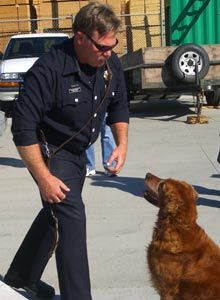 Photo Jamie Thompson Firefighter and Task Force 3 member Dave Ramsey works with his dog, Sandy, at Saturday’s event. View the Bark Force Slideshow |
Some dogs have issues — they’re normally the ones that can be found chewing anything they can get their teeth into or spinning in circles like whirling dervishes.
While these character traits are too draining for most pet owners, they are actually positive attributes in the eyes of those charged with finding the country’s finest search dogs.
However, selecting the right dog is only half the battle. With intense training programs required for both dog and handler, there’s currently a severe shortage of Advanced Certified canine search teams in the United States.
A total of 336 FEMA Advanced Certified canine search teams — 12 for each of 28 FEMA Task Forces — are needed to adequately respond to disasters, according to the Calif.-based Search Dog Foundation. There are currently only 150 such teams in the nation.
As part of efforts to boost canine recruitment, the SDF hosted a “Bark Force” training event at the South San Francisco Fire Department on Saturday, designed to encourage members of the public to work with the organization to evaluate potential search dogs.
Most are taken directly from shelters, with the SDF, a not-for-profit, non-governmental organization, then giving the dog professional training before partnering them with firefighters at no cost to departments.
New recruits
Karen Klingberg, manager of the SDF Bark Force, oversees the identification and evaluation of potential new canine recruits.
“Ninety-eight percent of the dogs in the program have been pulled from shelters or rescues, most of them from death row,” Klingberg told the training session at Station 61. “Many of these have a history of being uncontrollable.”
Hunting and herding breeds such as Labrador Retrievers and Golden Retrievers are favored as search dogs, while Border Collies are also occasionally accepted. Most of the dogs taken into the program are aged between nine to 18 months.
“When we go into the shelters looking for dogs, we look at their histories,” Klingberg said. “Many owners had them as puppies and were happy with them until all of a sudden they turn six to eight months and the owners say they turn into monsters.
But the reason for the animals’ unruly behavior, Klingberg said, is that they are not given enough to do.
Once selected for the program, the dogs are certainly given the tasks their personalities crave. They initially undergo six months of training at a kennel in Gilroy, Calif. Then after a period of several months of bonding and further training with their handler, they are ready for FEMA certification testing. Once a team is certified, continuous training is required to meet the standard required to be a Disaster Search Dog Team.
Among the most suitable dogs are those that are bold, energetic, athletic, outgoing and that have a strong prey/play drive.
When deployed, Klingberg said, they must be well socialized, yet focused enough to screen out and ignore distractions.
Intense training
During Saturday’s event, South San Francisco Firefighter Dave Ramsey, a certified handler, and his dog Sandy gave some basic demonstrations.
Becoming a dog handler gave the firefighter the chance to join the California Task Force 3.
“I’d always wanted to be a member of the team doing something, but after getting married and then having kids it never quite worked out,” he said.
“But then the kids got older and then this opportunity came along to become a dog handler.”
Firefighter Ramsey said while he was expecting it to be hard work during the training stages, he was still surprised at the intensity needed.
“There was 18 months of solid training for us,” he said. “We were together every day to get him up to where he could pass the FEMA test.”
While they have yet to be deployed with the Task Force, the levels of training they have undertaken mean they are fully prepared, according to Firefighter Ramsey.
“With things like the rubble training that we do, it’s important to get them comfortable with it, to build their confidence,” he said. “Now he will go to just about anywhere I ask him to go.
“But it’s a long process in the early stages. Some days they do exactly what you want them to, it’s great and you’re so happy, and other days they’re like ‘nah, not today, thanks.’”
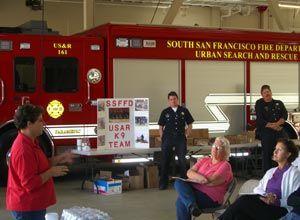 Photo Jamie Thompson Karen Klingberg addresses the Bark Force event held at Station 61. |
The pair has been together now for nearly four years, with Sandy having been accepted into the SDF program after his owner was unable to spend enough time with him during the day.
Lasting partnerships
Pairing up the right dog for the right handler can be a critical part of the process, according to SDF Program Manager Denise Hess.
“A lot of dogs come out of training and are more ready to go than the handler,” Hess said. “In these cases, we’d pair them with something like a Labrador, something that is more understanding.
“But Border Collies are so smart and are already thinking of the next thing they need to do, and are not really forgiving if you’re not at the same level as them.”
For firefighters looking to become a certified handler, Hess said it’s vital they check whether the local USAR Task Force has vacancies first.
If so, it’s not just the firefighters who need to have the time and commitment, Hess said, but their families and departments, too.
“The department, for instance, needs to realize the firefighter will need time off for training and they need to be willing to work with that,” she said.
“It’s really a big commitment for everyone.”