

Hot tension rods transfer heat into wood connections
My son John shot this unique truss in a church under construction in a Washing-ton, D.C., suburb. I don’t know if it’s a commercially available design or an architect’s creation. Regardless, the thin rods serve as tension members, and they would heat rapidly during a fire and deliver heat to their connections with the heavy wood compression members (just as some cooks use nails to heat the interior of baking potatoes). Thus, a fire could attack a connection on the exterior and the interior.
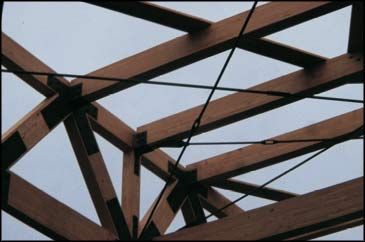 PHOTO JOHN BRANNIGAN |
A burnout of such a connection killed a fire officer as reported in NIOSH report #2002-44 and the May 2004 issue of FireRescue (“Structural Loads, Defined,” p. 120). Note that the NIOSH report text ends with the phrase, “pronounced dead.”
I suggest you show this picture to your local building department and lumber yards to learn if such trusses are in use in your response area. If so, tell the occupants to call the fire department if they smell smoke and not to wait until they find the fire. (It’s a fire department function to determine if smoke is friendly or hostile — it’s not a “false alarm.”) Also, place a write-up on any truss like this in a file at the alarm office so it goes out with a dispatch call to that building.
These trusses may be concealed in a void. If your thermal-imaging camera shows fire in the void in such a building, evacuate — there’s no way to determine time to failure.
If you obtain the name of a manufacturer of this type of truss, please let me know. And if you find one in use, I’d appreciate seeing pictures.
Francis (Frank) L. Brannigan, a fireground commander in the 1940s and a fellow of the Society of Fire Protection Engineers, was named one of the 20 most influential people in the fire service by Fire Chief Magazine. For 37 years, Brannigan has defined building hazards for firefighters. His book, “Building Construction for the Fire Service, Third Edition,” is available from the NFPA.