

| Editor’s note: Check out FireRescue1’s interview with Chief Jim Clack in the aftermath of last year’s bridge collapse in Minneapolis. |
By Ben Nuckols
The Associated Press
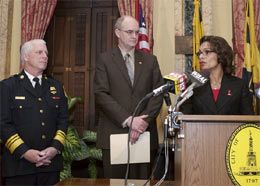 Photo Mark L. Dennis, Staff Photographer, Office of the Mayor Mayor Sheila Dixon names Clack Baltimore Fire Chief at a press conference Wednesday morning. |
BALTIMORE — Jim Clack, who oversaw the rescue operation after a disastrous highway bridge collapse in Minneapolis, was introduced Wednesday as Baltimore’s new fire chief.
Clack, the Minneapolis fire chief, was chosen from 40 applicants to succeed William Goodwin, who retired in December after a difficult year that included the death of fire department recruit Racheal Wilson during a training exercise.
“Chief Clack has proven that he can manage a crisis. He has proven that he can run a department effectively,” Mayor Sheila Dixon said. “And he has proven that he can build consensus among firefighters, the unions and their commanders.”
Clack said he was well aware of the circumstances surrounding Wilson’s death and had read an independent report that found 50 violations of national safety standards during the live burn that took her life. Another city firefighter, Allan Roberts, died while fighting a rowhouse blaze in 2006 - the department’s first line-of-duty death since 1995.
“Sharpening our focus on safety will be my first priority as your new fire chief,” said Clack, who added that he was pleased with the safety measures implemented by the interim chief, Gregory Ward.
Ward will remain as acting chief until Clack takes over in mid-April. Clack has to be confirmed by the City Council, and his compensation package has not been finalized. Ward said he was personally disappointed he didn’t get the job but added that Dixon “made an excellent choice.”
Clack, 48, had spent his entire 22-year firefighting career in Minneapolis. He was named chief in February 2007 and had been interim chief for 10 months before that. His predecessor, Bonnie Bleskachek, was reassigned following an investigation that revealed intimate relationships with other female firefighters.
The Interstate 35-W bridge collapse on Aug. 1, 2007, became the defining moment of Clack’s career. He was roundly praised for his calm and organized supervision of rescue efforts. While the collapse claimed 13 lives, “we rescued 50 people in an hour and a half and that is pretty impressive,” Clack told the University of Minnesota News in a recent interview.
The leaders of Baltimore’s two firefighters’ unions, who were sharply critical of Goodwin, said they were informed of Clack’s hiring Tuesday night and met with him Wednesday morning. They said he assured them that he would maintain close relationships with the unions.
“The last two years, there was absolutely no communication whatsoever,” said Stephen G. Fugate, president of the fire officers’ union. “That’s no way to run an agency.”
Fugate also applauded Dixon for selecting a strong candidate without regard to race but said Clack, who is white, may face a difficult confirmation hearing. Baltimore is 65 percent black.
 AP Photo/Eric Brandt Police and firefighters secure the area around the Interstate 35W bridge after it collapsed. |
But Dixon said she had spoken with Charles Rucker, president of the Minneapolis African-American Firefighters Association, and that Rucker told her Clack had worked to improve diversity in the department.
“He said, ‘If you want the best person and remove color from this process, this is the person for this job,’” Dixon said. Reached by phone, Rucker declined to elaborate on his conversation with the mayor.
Clack said he had visited Baltimore several times and had great affection for the city. While he has described himself as a “rural guy,” he said he plans to live downtown.
“Living and working in Baltimore is really a dream come true for me,” Clack said. “I know that there’s nothing better than a warm night at Camden Yards watching the Orioles, even if they’re not so good.”