

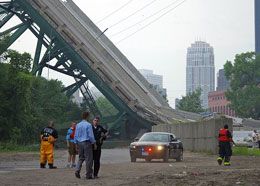
 AP Photo/Eric Brandt Police and firefighters secure the area around the Interstate 35W bridge, Wednesday, after it collapsed. |
MINNEAPOLIS — When a huge fire began devouring a huge block of downtown Minneapolis in 1982, the city’s fire department responded en masse.
All of its off-duty firefighters were immediately recalled to tackle the flames alongside on-duty crews.
These aggressive tactics had one problem though — there was no back-up as fatigue set in.
In the aftermath of the blaze, the department amended its off-duty firefighter recall SOP to call back smaller numbers of responders. It was utilized to full effect Wednesday when the eight-lane Interstate 35W bridge buckled during the evening rush hour.
Minneapolis Fire Chief Jim Clack was on his way home when he was radioed about the incident, which left at least four people confirmed dead and several others missing.
“You could tell it was a big deal straight away, as soon as our first units got there and reported what happened,” he said.
Available units
Amid the scenes of devastation, the incident commander at the scene sent out the call for all available units to be sent.
When Clack learned that every single on-duty fire truck in the city was in the process of being dispatched to the area, he stepped in.
“I wanted to keep a few in reserve, so I had to change that right away,” he said. “You need something in reserve, no matter how big the incident.”
As the seriousness of the collapse became apparent, Clack made the decision to recall off-duty firefighters.
But unlike 1982, when all city firefighters were immediately dispatched to the incident scene, he chose to recall only a portion of the 425-strong department.
“We initiated the call back system, and brought in about 40 firefighters,” he said.
This group was ordered to staff reserve equipment as about 80 on-duty firefighters had been sent to the scene.
Neighboring departments
In addition, said Clack, about 50 off-duty firefighters headed to the site unprompted where they were joined by 100 firefighters dispatched from neighboring departments.
“In an incident like this, it was important not to recall everybody at once, Clack said. “If you did that, everyone would get worn out.”
Clack, who became chief this year, joined the Minneapolis Fire Department in 1986, four years after the massive fire downtown that destroyed a bank and several other high-rise buildings.
“That was the fire that we learned about not calling back everybody at once,” he said. “Then, we ended up burning up all our crews on the first day, so we developed the policy that we used this time.”
When Clack initially arrived at the scene of the bridge collapse, he gained the perfect vantage point from a neighboring bridge about 100 yards downriver.
“I could see the whole scene, and looking at all the fire, all the vehicles still on the bridge and in the river was quite a sight,” he said. “It reminded me of a movie because it was so devastating.”
When emergency services crews arrived, a six-hour rescue operation began.
Tough task
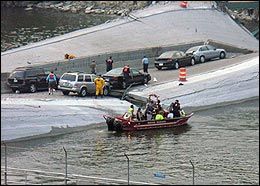 AP Photo/Jacob Reynolds A water rescue boat is seen near the wreckage of the Interstate 35W bridge, Wednesday. |
With both ends of the bridge destroyed, it proved a difficult task. Incident command was divided into north-south sectors.
“Figuring out access was difficult,” Clack said. “Some had to swim out there to get to the different pieces of broken bridge.”
At about midnight, the rescue operation was scaled down because of failing light, while dawn on Thursday heralded the start of recovery efforts.
Clack said he was pleased at the way his crews and other agencies responded
“Our inter-agency cooperation and all our disaster planning came into play and it seemed to work well,” he said.
| Related resources: Several killed in Minneapolis bridge collapse |