

| Editor’s note: Check out tips on taking a nap near the fireline at the end of this article. |
The Associated Press
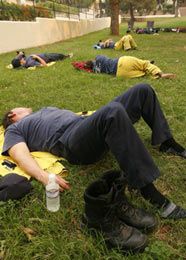 AP Photo/Gus Ruelas Firefighters rest after fighting four days of wildfires in Fallbrook, Calif., Wednesday. |
RUNNING SPRINGS, Calif. — Forty hours after he arrived in the San Bernardino National Forest, firefighter Peter Stanton stepped gingerly over a sleeping colleague and wondered what his next assignment was going to be.
“We’ve been going nonstop. I kind of hope they’re going to send us to sleep, but I’m pretty sure we’re going back out,” he said.
Meanwhile, crews found two burned bodies in a gutted house, authorities said Thursday, and flames drew perilously close to thousands of homes in Southern California’s firestorm despite a break in the harsh winds and a massive aerial assault.
From mountainside resorts to the shores of Malibu to the Mexican border, about 15 blazes destroyed at least 1,500 homes and threatened tens of thousands of others.
Stanton and his colleagues fought to save homes near the mountain resort area of Lake Arrowhead, and at times fought to stay clearheaded as they dragged hoses and drove fire engines into infernos.
“We are hearing about people getting tired,” federal Homeland Security Secretary Michael Chertoff told reporters in San Diego, site of some of the worst fires. He added he had spoken with other authorities about “the need to rotate firefighters out,” giving them time to rest.
“One of the big hazards is exhaustion, which leads to impaired judgment,” Chertoff said.
Tired relieving the tired
In some cases, however, the tired were relieving the tired. In northern Los Angeles County, some of the fire crews that had all but contained a 38,000-acre wildfire near Santa Clarita were being dispatched to the Lake Arrowhead area.
“We have no idea how long we’ll be gone for,” said firefighter Al Taylor of the state Department of Forestry. “We just show up and try and have a good time.”
He and his colleagues planned to catch some sleep on the ride to their next assignment, a little more than 100 miles away.
Firefighters are used to working to the point of exhaustion, Calipatria fire Chief Chris Hall said. He worked 35 hours straight on the Lake Arrowhead fires, got a few hours rest and then was back on the lines, helping mop up hot spots on a narrow street in Running Springs.
The firefighters take pride in the homes they’ve been able to save since the blazes began breaking out one after another, beginning Sunday. Some said they are frustrated that there haven’t been more people and equipment to help in the fight.
“We’ve just been really, really short on resources,” said Stanton, who arrived in the Lake Arrowhead area Monday with a team of 20 firefighters from Imperial County, east of San Diego.
Neighborhood abandoned
A two-pronged fire there in the San Bernardino Mountains has destroyed more than 300 homes so far. Stanton told of his crew having to abandon one small neighborhood in Running Springs when it became obvious that flames were going to overwhelm them.
Hours later, tired and in an almost dreamlike state, he described the scene:
“It was dark, the sky was glowing, the winds were blowing fiercely, and the longer we stayed the smokier we got,” he said. “The embers were getting bigger and thicker. I looked up, the entire ridge was glowing.”
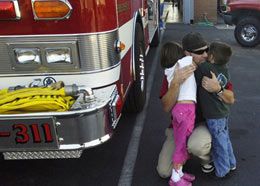 AP Photo/Idaho Press-Tribune, Greg Kreller Meridian, Idaho, firefighter Brandon Medica hugs his children before boarding a bus to Southern California on Wednesday evening. |
On Thursday, medical examiners were trying to establish the identities of the man and woman whose bodies were found near Poway, north of San Diego, said Sheriff’s Department spokeswoman Jan Caldwell. They were believed to be related, officials said.
Neighbors told officials they last saw the pair around midnight Monday when they told the two to evacuate, Caldwell said. They were reported missing sometime after that.
Flames also claimed the life of a 52-year-old man in Tecate. The San Diego medical examiner’s office listed seven other deaths as connected to the blazes because all who died were evacuees.
The number of victims could rise as authorities return to neighborhoods where homes burned.
The grim announcement came as the firefighters, aided by the calming Santa Ana winds and dropping temperatures, looked to gain control of some of the most severe fires. Firefighters had lost ground overnight on one Orange County blaze.
Shelters emptying
Some evacuees were being allowed back into their neighborhoods, and shelters were emptying. Qualcomm Stadium in San Diego, which sheltered more than 10,000 people at the height of the evacuations, had just 2,500 people left Thursday morning.
The hot, dry Santa Ana winds that have whipped the blazes into a destructive, indiscriminate fury since the weekend were expected to all but disappear. “That will certainly aid in firefighting efforts,” National Weather Service meteorologist Jamie Meier said.
But electricity was a concern. A wildfire cut a main power link with Arizona, while another blaze near Camp Pendleton was threatening the main north-south power corridor that connects San Diego with the rest of California. Additional power was being shipped from Mexico, said Sempra Utilities Chief Operating Officer Michael Niggli.
Even with the slackening winds, the San Diego County remains a tinderbox. Firefighters cut fire lines around the major blazes, but none of the four fires was more than 40 percent contained. More than 8,500 homes were still threatened.
Towns scattered throughout the county remained on the edge of disaster, including the apple-picking region around Julian, where dozens of homes burned in 2003.
To the northeast, in the San Bernardino County mountain resort of Lake Arrowhead, fire officials said 16,000 homes were in the path of two wildfires that had destroyed more than 300 homes.
The fires remained out of control, but were being bombarded by aerial tankers and helicopters that dumped more than 30 loads of water.
Aerial tour
President Bush, who has declared a major disaster in a seven-county region, took an aerial tour of the burn areas with Gov. Arnold Schwarzenegger.
“It’s a sad situation out there in Southern California,” Bush said outside the White House before leaving for California. “I fully understand that the people have got a lot of anguish in their hearts. They just need to know a lot of folks care about them.”
Losses total at least $1 billion in San Diego County alone, and include a third of the state’s avocado crop. The losses are half as high as those in Southern California’s 2003 fires, but are certain to rise.
The more hopeful news on the fire lines came a day after residents in some hard-hit San Diego County neighborhoods were allowed back to their streets, many lined with the wreckage of melted cars.
Running Springs resident Ricky Garcia returned to his house in the San Bernardino Mountains on Wednesday, panicked that his street had been wiped out and his cats, Jeff and Viper, were lost.
But his house, newly built on a cleared lot, was unscathed, unlike those of his neighbors. Hiding underneath a porch and mewing loudly was Jeff, his long, black hair gray with ash. Viper was nowhere in sight.
“I’m excited to see my cat and my house, but absolutely devastated for my neighbors,” he said, preparing to evacuate again.
As nature’s blitzkrieg starts to recede, many of the other refugees will be allowed back to their neighborhoods. More than 500,000 people were evacuated in San Diego County alone, part of the largest mass evacuation in California history.
“We are focusing more on recovery and getting these people back up on their feet again,” County spokeswoman Lesley Kirk said.
In the middle of the arc of fire, the Santiago Fire in Orange County had burned nearly 23,000 acres and destroyed nine homes. It had been 50 percent contained Wednesday, but firefighters lost ground overnight as it moved into the Cleveland National Forest.
Agents from the FBI and the federal Bureau of Alcohol, Tobacco, Firearms and Explosives were sent to help investigate. Authorities said a smaller, more recent fire in Riverside County also is linked to arson.
Police shot and killed a man who fled Tuesday night when officers approached to see if he might be trying to set a fire in San Bernardino. The man, whose name was not released, had led police on a chase then backed his car into a police cruiser, police said.
___
Taking a nap near the fireline — courtesy of the Federal Fire and Aviation Safety Team.
Firefighting is often exhausting work and firefighters can find themselves needing to sleep while on the fireline. Before pausing to rest, firefighters must weigh the following considerations:
- Are lookouts posted? Discuss who that lookout can be. Can the lookout on the knob across the draw watch over you or does it need to be your partner on the fireline alternating rest times?
- Is the area free of hazards? (Falling snags or rolling materials) Discuss what you need to do to create a safe resting area.
- Are you still within agency work and rest guidelines? Review what these guidelines are.
Does your crew need a break? Have they been pushed too hard? Talk about situations where you need to simply take yourself and/or your crew off the fire for uninterrupted rest. To reduce risks:
- Keep lookouts posted; rotate lookouts.
- Communicate crew conditions and status to supervisor or chain-of-command contact. Have firefighters discuss ways that they fine to rest on the fireline and suggestions for methods to to alternate shifts for more effective firefighting.
Check out FireRescue1 tips special: Wildland firefighting for more tips.