

The Associated Press
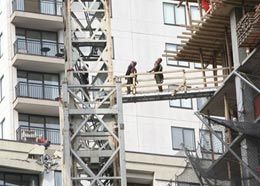 AP Photo/Diane Bondareff Crews work to remove the damaged crane on New York’s Upper East Side, Saturday. |
NEW YORK — The towering cranes that build America’s skyscrapers are often not properly inspected for wear, fatigue and other potentially dangerous structural problems, several construction safety experts said following a deadly accident in New York.
Two construction workers died Friday when the huge cab of a 200-foot-high construction crane popped off its mast and plummeted onto a Manhattan street, sheering off part of an apartment building on the way down.
Crane accidents in Wyoming and Nevada on Saturday that killed one person and injured three, underscore the risks involved with working around cranes.
Investigators probing the New York accident have focused on a possible defect in the turntable that connected the cab to the crane’s tower.
Acting Building Commissioner Robert LiMandri said a weld in the mechanism appeared to have failed. He said forensic experts were examining the break and tracking maintenance records on the turntable, which was part of an aging crane made by the defunct company Kodiak that had been in service since 1984.
Just why the weld came apart was unclear, but crane inspectors and engineers who spoke with The Associated Press on Saturday expressed dismay — but not surprise — that the problem hadn’t been uncovered during safety checks.
Greg Teslia, president of Crane Safety & Inspections Inc. in Coral Springs, Fla., said construction workers handling the giant machines often lack the expertise to spot structural problems.
“Their knowledge is fairly limited, along with their education,” Teslia said. “You cannot take a one-week course at some facility, and all of a sudden say that you are a crane inspector, and that’s what I think is happening.”
Jeff York, a crane safety consultant in Hayward, Calif., said many things can go wrong with a crane as it ages. Bolts can loosen and stretch. Cracks can develop. Most of these things can be detected, but he said those checks are sometimes performed poorly, or not done at all.
“There is no oversight for this type of work,” said “There are people who are rubber stamping this stuff,” he said.
Gene Corley, a structural engineer and vice president of CTLGroup, said there is no national standard for checking cranes for cracks caused by fatigue, even though there is a need for such checks and devices are available that can perform the tests accurately.
In northeastern Wyoming on Saturday, three people were injured when a large crane collapsed as it moved a pipe across a rail line at the Black Thunder coal mine near Wright, authorities said.
“It’s completely toppled over; it’s a mass of blue, twisted metal,” said Campbell County Sheriff’s Deputy C.T. Akers. Two of the injured were in critical condition.
And in Las Vegas, a worker was crushed to death by a crane at the construction site of the MGM Mirage’s CityCenter casino resort in Las Vegas, authorities said.
The worker was oiling the crane when he apparently became caught between the its weight system and track, said Clark County fire spokesman Scott Allison.
The crane didn’t fall, and no one else was injured.
There have been several other deadly crane accidents in recent years.
A section of a crane collapsed in Miami in March, killing two workers and smashing a home. A construction worker died in Annapolis, Md., in April after a section of a crane came loose as it was being dismantled. A crane collapse that crushed buildings and killed a man in Bellevue, Wash., in late 2006 prompted an overhaul of that state’s safety regulations.
The accident in New York came just 2 1/2 months after another crane collapsed in midtown Manhattan, killing seven people.
The city’s building commissioner convened an emergency meeting of about 80 area construction executives Saturday to talk about crane safety. The meeting was closed to the public, but LiMandri said afterward that officials are focusing on the possible turntable defect.
“The crane cab completely came apart from the mast in a way that allows us to, and has drawn us to, focus on the actual turntable,” LiMandri said. “We have reviewed, based on some photographs, that a weld, or structural member, may have had fatigue.”