

By Jamie Thompson
FireRescue1 News Editor
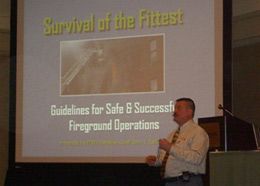 Photo Jamie Thompson John Salka delivers his session Wednesday. |
INDIANAPOLIS — The early arrival of fire departments on scene and adequate staffing to initiate tactics may seem obvious ways to ensure safe fireground operations. But all too often, the most basic things are often the most vital — and are often overlooked.
During an education session at FDIC Wednesday, FDNY Battalion Chief John Salka outlined measures that can ensure both safety and success at incidents.
However, he told the audience that fatalities among firefighters are sometimes inevitable, no matter what. Of the more than 1 million firefighters in the United States, he said, about 100 die every year.
“I know that it’s contrary to what everybody else says, but I think 100 out of 1 million ain’t bad,” he said. “There’s a lot of fires out there and there’s a lot of dangerous conditions.”
That said, there are several underlying reasons why a department’s operations can fail, according to Salka.
One of the biggest, he said, is the delayed arrival of firefighters at the emergency scene, which can be caused by a range of factors.
A major issue affecting response times is the location of fire stations, Salka said. He outlined how surrounding areas around many firehouses today are often unrecognizable from when they were first built.
New developments
Fire districts are expanding all the time, he explained, meaning many older firehouses can be miles away from new housing developments.
Salka urged those building new stations to carefully study where they should be positioned in order to best benefit their community. Substations can also remedy response-time problems in newly developed areas of districts, he added.
A lack of familiarization with the local area is also a factor in delayed responses, Salka told the audience.
“Just one missed or wrong turn on route to an emergency or fire can add valuable time to the response,” he said. “All officers and apparatus drivers need to be familiar with their entire response area.”
This lack of familiarization can present problems in other areas as well, he added.
“I know for sure that there are people who have bought fire trucks and about three months later on a rescue call discover that a bridge is lower than that truck is high,” Salka said.
“That’s unforgivable. They didn’t build the bridge after the truck. Don’t you think that when buying a fire truck, someone should check every road and that there’s clearance everywhere?”
Salka went on to add the importance of a strong command element at incidents.
“When a second chief arrives at a fire scene, the subordinate chief should be assigned to inside the building to supervise the fire floor, the floor above or other vital areas of operations,” he said.
“It makes little sense to have three or four chiefs standing together at the command post.”
Other areas that can help to ensure safe and successful fireground operations, Salka explained, are proper and operational equipment and dependable mutual aid/multiple alarm procedures.
In closing the session, he said, “If your fire departments and firefighters are adequately trained and equipped to initiate and create an aggressive interior attack, that will result in a safer environment and a reduction in the losses suffered by the fire department community.