

By Steve Harrison, Peter St. Onge and Sharif Durhams
The Charlotte Observer
 |

CHARLOTTE, N.C. — Salisbury firefighters alternated between going inside the Salisbury Millwork to try and extinguish the deadly fire March 7, then falling back and playing defense when the blaze threatened to overwhelm them.
And as the fire engulfed the entire building, they complained frequently about not having enough water pressure, according to recordings of firefighter communications.
At 9:06, a frantic call came in: “Mayday! Mayday! Mayday!”
The early morning fire killed two Salisbury firefighters inside the millwork. Last week, City Manager David Treme ordered the city’s fire chief to create a panel of experts to evaluate how the department handled the blaze. Investigators have said the fire wasn’t arson, and that the fire started above a false ceiling in a basement below the millwork’s office.
Salisbury Fire Chief Bob Parnell said Friday at a news conference that his firefighters “did exactly what they were supposed to do.” He couldn’t be reached Tuesday.
The fire was reported at 6:58 a.m. by a millwork employee, Tony Dowell, who saw smoke streaming from the office as he arrived for work. Dowell said he told firefighters he was the first person at work. At 7:19 a.m., a commander at the scene said over the radio: “Employees... give me a verbal all clear of the structure.”
Convinced no one was inside, Salisbury firefighters were focused on saving the building. A firefighting plan for the millwork created years earlier warned a fire there would spread quickly, fueled by adhesives and other flammable materials.
By 7:21 a.m., with firefighters on scene, the on-scene commander reported the fire had spread from the basement to the first floor. A few minutes later, a commander said all personnel were “pulling out of the structure.”
It’s unclear if all firefighters left the basement and office.
Over the next half an hour, additional units were called to the millwork — and firefighters regrouped to stop the blaze. The millwork’s manufacturing area and warehouse weren’t yet on fire.
During that time, firefighters were inside the building. It’s unclear if they were sent back in or had never left.
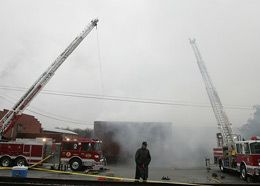 AP Photo/Jason E. Miczek Firefighters tackle the March 7 fire. |
At 8:03 a.m., the on-scene command said: “Crews are all in place for an offensive operation. All crews remain committed on scene.”
Over the next few minutes, firefighters sounded increasingly concerned.
At 8:08 a.m., an unidentified firefighter said: “We’ve just had a flash up on the first floor... We’ve got active fire on the first floor.”
Seconds later, firefighters said they were going “to back them (firefighters) out of the basement.”
At 8:15 a.m., firefighters decided to evacuate everyone from the building and “regroup.”
By 8:32 a.m., the situation was more serious. Part of the floor collapsed into the basement, according to audio tapes. All firefighters were ordered out of the building, again.
Ten minutes later, a new strategy emerged: “Our primary focus is defensive... keeping that fire out of the warehouse. If you can keep your eye on the back side of that warehouse, I believe we’ll be all right.”
Part of that strategy was apparently to keep part of one team inside the warehouse and manufacturing area, directing water at the fire in the office and basement area.
Around 9 a.m., firefighters were concerned when they couldn’t reach by radio some of the team inside the warehouse and manufacturing area. A safety team was dispatched inside, and found the team was OK.
But four minutes later, a firefighter reported he needed water.
At 9:06 a.m.: “Mayday! Mayday! Mayday!”
It isn’t clear which firefighter said that.
A minute later, a firefighter apparently found a hose.
“I’m on the hoseline, but the hoseline’s gone dead!” he said.
Recordings then show firefighters calling for EMS services. Firefighters Victor Isler and Justin Monroe were pulled from the warehouse and manufacturing area later. Isler was pronounced dead on arrival at Rowan Regional Medical Center, and Monroe died at the scene.
As the fire spread to the warehouse and manufacturing area — which contained most of the flammable materials — firefighters ringing the building complained about not having enough water. The department’s pre-plan said it could expect 4,300 gallons per minute. If the millwork was completely on fire, it would need more than 11,000 gallons per minute.
At 9:33 a.m., the command said: “Notify the water department and advise them we need to boost water pressure...”
Firefighters began to stretch hoses across nearby railroad tracks to tap other hydrants. But they had to scramble at least once, about 9:35 a.m., when a train approached Salisbury.
At 10:10 a.m., firefighters asked again for more water.
The response, two minutes later: The water department said the pressure is “as much as they can do to this point.”