

By Brian Meyer
The Buffalo News
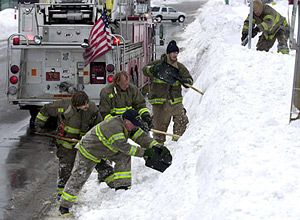 AP Photo,David Duprey Buffalo firefighters dig out buried hydrants in this file photo. |
BUFFALO, N.Y. — Skyrocketing overtime in the Buffalo Fire Department is “breaking the budget,” city officials warned Friday, and they’re plotting a strategy aimed at wiping out overtime by December.
Two top advisers to Mayor Byron W. Brown said current policies must be radically overhauled.
“I’m at the point of saying ‘forget the overtime,’” said Finance Commissioner Janet Penksa.
At a time when the nation is in a “deep, deep recession,” Penksa said, many firefighters are doubling their incomes through overtime.
“It’s abusive,” Penksa said. “You have firefighters making $165,000 a year when you factor in overtime.”
“The system is absolutely broken and needs to be fixed,” said First Deputy Mayor Steven M. Casey.
Their comments follow a series of articles in The Buffalo News that focused on escalating overtime in the Fire Department and how it has allowed many employees to pump up their pensions.
Penksa praised the series for its analysis of a looming fiscal problem. She presented some of The News’ data to the city’s accountability panel.
Overtime approached $10.6 million
The News found that five years ago, the Fire Department spent about $2.2 million in overtime. Last year, the overtime tab approached $10.6 million.
The overtime, The News found, helped increase average firefighter annual pay in 2008 to $79,970, up from $61,461 in 2004 — even with the wage freeze that was in effect for most of that time.
The extra money, however, was not spread out evenly. Firefighters who retired in 2008 earned, on average, about $110,000 in the year before their retirement, with an average of about $45,000 in overtime. Average pay for those not retiring was about $70,000 with less than $16,000 in overtime.
The result was a five-fold increase in average pensions — from $42,360 in 2004 to an estimated $65,000 in 2008. Many of the 2008 pensions, The News found, exceeded a firefighter’s base pay.
For the first time since the overtime surge surfaced over the past couple of years, Penksa said she thinks a strong argument could be made for hiring new firefighters to fill all vacant jobs. When vacancies and disabled firefighters who are out for long-term injuries are tallied, Fire Commissioner Michael S. Lombardo said, the department is typically down about 67 members.
“I’m almost at the point where I think we should put enough firefighters in the budget to eliminate overtime — period,” Penksa said.
That would be similar to the way the Rochester Fire Department operates.
With about 613 active firefighters, The News found that Buffalo currently has roughly 23 firefighters for every 10,000 residents. Staffing is slightly higher in Rochester, which has 25 firefighters per 1,000. That department, however, keeps overtime to a minimum.
With an additional 67 firefighters, Buffalo also would have 25 firefighters per 10,000 residents.
Unions blame staffing shortages
In the past, some Buffalo and fire union officials have defended the dramatic increase in overtime by pointing to staff reductions and an earlier hiring freeze. They also have argued that some overtime can save the city millions of dollars in long-term payroll and benefit costs.
The union representing firefighters will likely have a formal comment early next week, said Martin V. Barrett, sergeant-at-arms for Buffalo Professional Firefighters Local 282. But speaking strictly for himself, Barrett said he views it as “wonderful” news that the city is finally talking about providing adequate staffing in the department.
“They basically created the problem by not hiring,” said Barrett. “They’ve apparently found a solution. If it was that simple, they should have done it years ago.”
Lombardo conceded that the public views sky-high overtime as a “horrid thing,” and he said he takes full responsibility.
“But it’s basically tied to minimum staffing requirements,” he told the CitiStat panel.
Efforts have been made to control overtime “wherever we can,” Lombardo said. But the fire commissioner said the city is obligated to follow minimum staffing mandates. The union contract requires it, he said, and public safety dictates that manpower guidelines be strictly followed.
Casey questioned whether it is in the interest of public safety to let some firefighters work large amounts of overtime in a given week.
“You’re going to be off — you’re going to be tired,” Casey said of those firefighters who work many extra hours.
Firefighters with the most seniority get the most overtime, meaning that older workers on the force are often working the most hours.
Penksa said it’s unfortunate that repeated efforts over the past three years to reach a contract settlement with the fire union have been fruitless. If a settlement had been reached, she said, perhaps many of the fiscal problems in the Fire Department would have been resolved.
Penksa said budget analysts will be running the numbers in the coming weeks to see how many firefighters would have to be hired from a new list of recruits to either “completely eliminate” overtime or keep it at a minimal level.
A new class of firefighters — whatever its size — will likely begin training in September and should be on the streets by December, officials said.
Copyright 2009 The Buffalo News
All Rights Reserved