

By Tom Faure
Chattanooga Times Free Press (Tennessee)
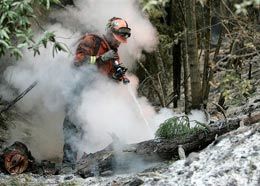 AP Photo/Marcio Jose Sanchez A California Dept. of Corrections firefighter is covered in smoke during mop up duty at the Big Sur fire in Calif., Saturday. |
CHATTANOOGA, Tenn. — Retired firefighter Lorenzo Abundiz never smoked a cigarette in his life, but he said all the smoke and toxins he encountered on duty were just as bad for him.
The California cancer survivor, his wife, Peggy, and fellow firefighter John McKnight visited Chattanooga on Saturday as part of a cross-country journey to douse the flames of cancer.
The Code 3 for a Cure team spoke Saturday to about 16 members of the Fire Department’s Station No. 1 crew and are now on their return trip, heading to Nashville next.
“The organization was formed because of my tiredness with the fight against cancer and all my friends and comrades who died of cancer. I just wanted to do something,” Mr. Abundiz said. “It’s not just for firefighters. If we can find a cure for cancer, it’ll affect everybody.”
The group has been stopping for lunch and discussions at fire stations across the country, taking down names of firefighters who lost their lives to cancer and reading the names in prayer ceremonies. In Los Angeles alone the team took down 62 names.
Firefighters face greater risks of cancer and related diseases than the average person, Mr. Abundiz said. Putting out fires brings them in contact with a number of toxic household materials that enter the body as smoke or can infiltrate the skin despite protective gear.
“They don’t get a chance to enjoy their retirement,” he said. “Many lay down their fire ax for the last time, go off to retire and four to seven years down the line they die of cancer.”
Mr. Abundiz retired in 1998 and beat the disease despite a 4 percent survival chance. He described painful treatments for sarcoma, bladder cancer and more than 250 surgical procedures. This year he started Code 3 to raise research funds, honor past firefighters and educate firefighters about cancer and how to deal with it.
To facilitate the sometimes frustrating worker-compensation process, Mr. McKnight advised the Station No. 1 crew members to keep a log of all the calls they answer. That way if they get sick they won’t waste key months building a list of fires they might have encountered decades before. Mr. Abundiz added that, even after a diagnosis, patients should seek more than one doctor’s opinion, a move that he said helped him keep his right arm.
Mr. Abundiz filmed a video in which Deputy Chief Randy Parker and his crew sent a message to firefighters suffering from cancer and other diseases.
“Get well!” they yelled, their voices bouncing off the large four-truck garage at Station No. 1 on Main Street.
The Code 3 members asked the Station No. 1 crew to help spread their message. The firefighters did not appear discouraged by the presentation, despite the somber outlook.
“I think it’s a good cause,” Deputy Chief Parker said. “When you look at who dies, a good percentage are from cancer.”
He noted that many carcinogenic toxins did not exist in your average garage 30 years ago. More burning plastics and other combustibles mean more risk for firefighters. He said the department now pushes personnel more vigorously to use protective gear and breathing apparatuses, even for seemingly safer incidents like car fires.
The Code 3 for a Cure team left Los Angeles June 13, visiting 46 stations and hundreds of fire personnel to date. After making a total of 60 stops and nearly 10,000 miles, they plan to arrive home in mid-July.
Meanwhile, firefighters in their home state are contending with destructive wildfires. Mr. Abundiz’s son Jeremy left the team in New York to return to California and fight the wildfires. Mr. McKnight said that he also might join those fighting the conflagration once he gets back.
Copyright 2008 Chattanooga Publishing Company