

| Editor’s note: Check out FireRescue1 columnist Michael Lee’s article on technical rescue operations for tips and advice on handling incidents such as those highlighted in the following article. |
By Angie Leventis and Nicholas J.C. Pistor
St. Louis Post-Dispatch
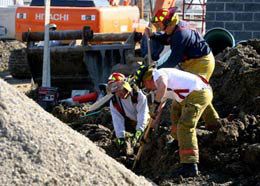 AP Photo/Belleville News-Democrat, Paul Baillargeon Rescuers dig at the site Monday. |
MILLSTADT, Ill. — The construction site where two workers were killed in a trench collapse on Monday was cited about four months ago for inadequate safety measures, according to the U.S. Department of Labor Occupational Safety & Health Administration.
Followell Construction Co., based in Marion, Ill., was fined $1,400 in November for failing to provide guardrails or safety net systems for two workers on a 24-foot-high pitched roof. Followell is the general contractor on the project.
OSHA investigators are now trying to determine whether proper precautions were used in the 8- to 10-foot deep trench that caved in and killed Walter T. Eickelman, 48, of Benton, Ill., and Ron Yankey, of Ellis Grove, Ill.
“It’s very important for companies to follow our requirements,” said Nick Walters, OSHA director in Fairview Heights and Peoria. “If they do that, the odds of an employee being at risk are very low.”
Walters said he could not comment on the specifics of this case until the investigation is complete, which could take as long as six months.
In general, he said labor laws require one of three safety mechanisms if a trench is deeper than 5 feet: sloping (creating steps in the dirt walls), shoring (metal or wood barriers against the walls), or using a steel cage or trench shield.
Ben Followell of Followell Construction would not answer any questions about safety, and referred them to the subcontractor that employed the workers, Midwest Petroleum & Excavating Inc., based in Benton. No one there could be reached for comment.
If OSHA does find safety problems, both the contractor and subcontractor could be held accountable.
Authorities said there was no visible safety cage or barrier to protect the workers; they aren’t aware if any other safety precautions were taken.
The victims were working on a $7.4 million sewer plant for the village of Millstadt. Mayor Bruce Nowak said construction work will be halted for the rest of the week.
Authorities don’t know what caused the cave-in. First, the dirt collapsed around one of the victims, and then the other victim went after him and also became trapped in a wave of dirt.
“When I arrived, one man was partially visible in the trench, but the other was still buried,” said Brian Donley, deputy chief of St. Clair County Special Emergency Services.
The two workers were smothered to death, said officials at the St. Clair County coroner’s office. The search and recovery effort took about seven hours. Donley said emergency responders had to shore up the collapsed area, and then use hand shovels to reach the two men.
Robert Curl, 46, of New Baden is one of the few men who knows what it’s like to be buried alive.
He was the victim of a trench collapse in Fairview Heights about two years ago. He said his supervisor sent him into a 15-foot hole with no safety mechanisms, and the dirt started to cave in. Curl said it “looked like a black shadow,” and he started beating back at the soil with his shovel.
“It feels like your throat’s slit,” he said. “You’re gagging because there’s no oxygen. You can’t move.”
Just when Curl said he was “making his peace with Jesus,” a hole opened up above him, and his co-workers were able to dig and pull him out.
Nationally, trench collapses are the second-biggest killer of construction workers, according to OSHA.
A plumber died in a trench collapse in 2005 while installing a sewer pipe just north of Forest Park in St. Louis. The sides of the trench had not been reinforced.
Another plumber and his assistant suffocated to death in 2004, when a 12-foot trench collapsed on them in Greenville. There were no safety precautions used in this case, either.
But OSHA officials said this region has recently made great gains in excavation safety.
The Millstadt collapse was the first fatal accident of its kind in most of the Midwest since 2005, according to OSHA. This includes private employer accidents in Illinois, Ohio, Indiana, Michigan and Wisconsin.
“This number used to be in the double-digits (annually),” Walters said.
He credits the decrease in deaths to a greater emphasis on safety in the 1990s, when the department started doing random work site investigations and more construction education and outreach. For example, in the last five months, OSHA held five excavation safety seminars in the areas surrounding Peoria and Fairview Heights.
Copyright 2008 St. Louis Post-Dispatch