

Reno Gazette-Journal
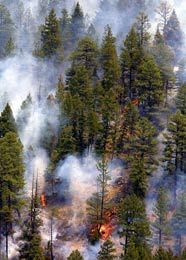 AP Photo/Nathan Bilow A fire burns out of control in the San Juan Forest near San Durango, Colo. in 2002, a season that saw several dangerous fires in the area. |
SPARKS, Nev. — Efforts must be made around the West to treat fire-prone landscapes in an effort to prevent increasingly devastating fire seasons, a federal official said.
Stopping the spread of cheatgrass and other invasive plants that help fuel fires will be expensive, but the move is increasingly critical as a warming climate creates longer and more intense fire seasons, said C. Stephen Allred, assistant secretary of the Interior.
“The challenges we have with fire are huge,” Allred told the Reno Gazette-Journal before a speech Monday to a convention of the National Association of Conservation Districts in Sparks.
Last year, about 9.3 million acres burned nationwide. The toll was even worse in 2006, 9.8 million acres burned nationally, according to the National Interagency Fire Center in Boise, Idaho.
“I expect they portend things to come in the future,” Allred said, citing climate change as a potential key factor.
No matter where one stands in the debate over the cause of a warming climate, there’s little doubt the phenomenon is worsening the danger of catastrophic wildfires, Allred said.
“There’s no question we are in a period of pretty rapid change and decreasing moisture,” he said.
Worsening fire seasons in the West are now followed by increasingly serious ones in the southeast part of the country, Allred said. Firefighters continued to battle hundreds of fires in North and South Carolina that ignited over the weekend.
The national fire center in Boise, Allred said, used to be a seasonal operation.
“No more,” he said. “It’s a year-round operation, and there are no down times.”
It’s not enough to fight fires while they are burning, Allred said. He said it is also critical that steps be taken to restore burned areas.
Cheatgrass, named for its ability to cheat the seeds of other vegetation out of water and nutrients, crowds out native grasses and sagebrush, ignites easily and quickly sprouts in burned areas to provide fuel for future fires.
The annual grass now dominates at least a third of the 48 million acres of Nevada managed by the U.S. Bureau of Land Management and is also spreading across Utah, Idaho and Oregon.