

By Richard Gaines and Patrick Anderson
Gloucester Daily Times
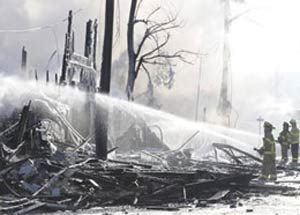 AP Photo/Lisa Poole Firefighters hose down the four-story apartment building that was gutted by fire in Dec. 2007. | |||
| Related: Report: Lorraine Apartment fire after action report (PDF) Report: Lorraine Apartment fire report appendices (PDF) Article: Mass. chief retires after scathing report into fatal fire Article: Mass. fire kills one person, destroys synagogue | |||
|
GLOUCESTER, Mass. — Still on the job at Central Fire Station yesterday afternoon, Chief Barry McKay disputed the Municipal Resources Inc. assessment that there was a leadership vacuum at the scene of the December 2007 Middle Street fire, and said the report painted a far more “bleak” portrait of the fire and the department’s response to it than was warranted.
But McKay said he understood the value of the work that went into the report and preferred to focus on its recommendations rather than argue over its critiques.
“I disagree with some of the conclusions, but it is what it is,” McKay said. “The report was based on a lot of people’s opinions, we need to focus on the 30 or so recommendations.”
More than 100 firefighters responded to the eight alarms from as far away as Concord in the overnight hours. But the firefighting effort was frustrated by disorganization and insufficient water pressure.
“The lack of a command structure during the peak of the incident was an important factor in the final outcome,” the Municipal Resources consultant wrote in the report. “There was also a lack of leadership. The issue of leadership by the fire chief appears to have been an ongoing situation with the command staff and the officers in the department.”
This disconnect was a “contributing” factor in the “inability to gain control over the incident at its earliest stages.”
The description of McKay in the report is of a chief so committed personally to fighting the fire that he forgot the obligation to organize and use a command structure against a wildly powerful and dangerous inferno.
First actions
The narrative description of McKay’s first actions on arriving on the scene at about 12:10 a.m., 25 minutes after a resident reported a fire alarm and smoke illustrates the syndrome:
“The chief chooses not to assume command and walks around the building to perform a 360-degree, size-up and to evaluate the interior conditions on the first floor,” the report reads. “He does so without donning full personal protective equipment, including the self-contained breathing apparatus, which is in direct violation of all safety considerations.”
For some time, the fire was hidden from sight and known only by its smoke.
Flames were first seen in the basement at ground level — not 20 yards across School Street from the Central Fire Station in a compact section of homes close by Sawyer Free Library and City Hall.
By then, firefighters were all over the upper floors seeking the source of the fire and residents to evacuate, and in the process risking their lives. “Two firefighters were operating without any charged hose lines and were operating about the fire floor,” the narrative reported.
“It was an inappropriate thing, but you only have so many resources,” McKay said about the initial rescue attempts in the building that went ahead against accepted procedure. “We all agreed and critiqued it afterward; we knew it was unsafe. But we did have lives that would have been lost. We brought out six people.”
“We needed more personnel on duty,” he added.
McKay took command of the scene at 12:20 a.m.
About then, Deputy Chiefs Phil Dench and Miles Schlichte arrived to discover a weakening of water pressure from the first ring of hydrants, and after consulting with the Department of Public Works decided to tap the 20-inch main along Rogers Street, bypassing the older and smaller main on Main Street.
Water source
While the secondary water source was being tapped, back at the Lorraine, McKay was directing a desperate effort to reach and recover “a person (who) was seen in a third-floor window on the (east) side of the building.”
McKay “directs two firefighters to take a 35-foot ladder” to reach the person who was later determined to be Robert Taylor, the handyman who perished in the blaze.
“It is apparent at this time that the command and control is minimal and that no specific divisions or groups or other positions with the ‘incident command system’ have been assigned,” Municipal Resources wrote.
At all times, though, the determination of the firefighters matched McKay’s, leaving many in mortal danger as crews tried to work their way to the place on the third floor where Taylor was trapped.
“Due to the large amount of fire,” the narrative continued, “crews were unable to make much progress. They were aware that the floor was beginning to feel soft and spongy, which is an indication of imminent collapse. They also detected high heat conditions and found fire in the floors, walls and ceilings through the use of the thermal imaging device.
“The crew passed by two rooms with heavy fire, reported severe fire conditions and made the following radio transmission: ‘Floor very weak, large amount of heat and fire, unable to make progress.’”
The Lorraine was evacuated almost immediately after that.
Later McKay was directing a ladder truck to put “the nozzle directly in the building window.” The report cited this detail as “an example of micro-managing a job function or duty versus the use of a chain of command.”
McKay yesterday said the suggestion that there was a leadership vacuum at the scene was untrue.
“Both me and (Deputy Chief) Steve Aiello were providing as much leadership as possible.”
Dench, the department’s senior officer after McKay, said yesterday he had not read the report, but praised the chief’s hard work and dedication.
“You have to realize that with all the constraints, we are under-staffed, under-trained,” Dench said. “The department has had its problems and most of it comes from the economics of the time.”
Copyright 2009
Gloucester Daily Times (Massachusetts)